

Remaining in RESICO as an individual requires separate checks on income, monthly compliance and personal circumstances. A high forecast does not establish that you have already exceeded the limit; a submitted return does not, by itself, prove payment. A monthly evidence file helps identify discrepancies and determine what needs attention before a delayed review makes the situation harder to assess.
What determines continued eligibility
Publicación de InstagramMostrarOcultar
Original Fintax Instagram publication about remaining eligible for Mexico's RESICO regime.
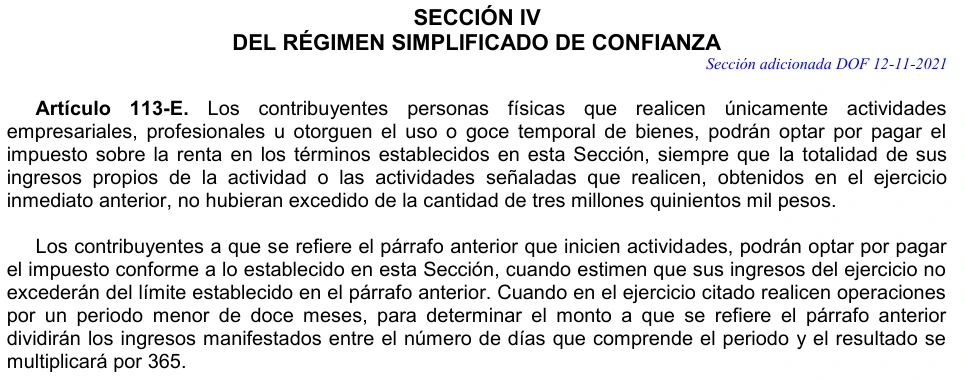
Article 113-E covers qualifying business, professional and rental activities carried out by individuals, with a prior-year income limit of MXN 3.5 million. It also allows salary and interest income subject to combined eligibility conditions. Review both the previous year and income actually received during the current year, classified by its nature. Income Tax Law, Article 113-E.
Partner or shareholder status needs a specific review: statutory exclusions and narrow RMF exceptions exist, rather than general permission for any ownership interest. Keep documents showing acquisitions, transfers or ownership changes, and request a written assessment of their effect. Income Tax Law, Article 113-E; 2026 Miscellaneous Tax Resolution, Rule 3.13.9.
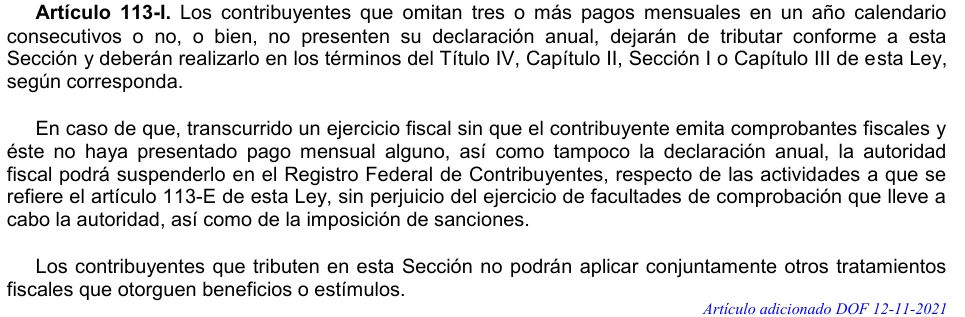
Article 113-I provides for departure from the regime when three or more monthly payments are omitted in a calendar year, whether consecutive or not. Do not restart the count after a compliant month. To assess this trigger, identify filed returns and completed payments separately. Income Tax Law, Article 113-I.
Build a file that supports decisions
The following structure is a recommended control, not a legally prescribed filing format. Each record should let you reconstruct what happened, when it happened and the evidence supporting it.
| Issue | Evidence to review | Practical action |
|---|---|---|
| Income and limit | Receipts ledger, income classification and prior-year total | Separate actual receipts from forecasts and review the applicable aggregate |
| Missed monthly obligations | January-to-December record of returns and payments | Count consecutive and nonconsecutive omissions |
| Filing versus payment | Separate filing acknowledgement and bank payment confirmation | Investigate any discrepancy between them |
| Personal changes | RFC status and ownership documents | Request a written eligibility assessment |
| Credential preparation | e.firma validity and tax mailbox confirmations | Prepare for the requirement applicable from 2027 |
Example: an income alert and a missed-payment alert
Assume a consultant already registered in RESICO has recorded MXN 2.8 million in accumulated qualifying income from January through September and expects to collect MXN 0.9 million from October through December. Her forecast is MXN 3.7 million. These amounts relate to her professional activity, and the file still needs confirmation of whether she has other income relevant to eligibility.
The MXN 3.7 million forecast warrants close monitoring, but it does not mean she has already collected that amount. She should update actual receipts and verify their classification against the applicable limit. Recording each receipt date helps identify when a potential breach occurs, rather than treating a business expectation as an established fact. Income Tax Law, Article 113-E.
Her February, May and August returns are also missing; assume the review confirms that the corresponding monthly payments were omitted too. These are three nonconsecutive omissions within the same calendar year. She should escalate the matter immediately rather than wait for a fourth. Later filing does not guarantee retroactive eligibility. Income Tax Law, Article 113-I.
What the 2026 relief changes

The 2026 RMF establishes definitive monthly payments and relief from the annual return for individuals' RESICO income. That is the scope of the relief: salary and interest income may independently require annual reporting where applicable. Certain co-ownership situations allow an annual-return election and need a specific review. 2026 RMF, Rules 3.13.7 and 3.13.8.
The Fifteenth Transitional Provision sets January 1, 2027 for application of the tax mailbox and e.firma requirement covered by Article 113-G, section II, and Rules 3.13.32 and 3.13.33. This is neither a general exemption for all taxpayers nor a basis for claiming immediate removal in 2026 because those credentials are lacking. Organizing them now is recommended preparation. 2026 RMF, Fifteenth Transitional Provision.
How to complete the monthly review
- Update the receipts ledger and retain evidence supporting each income classification.
- File the acknowledgement and payment confirmation by month, without treating either as a substitute for the other.
- Record changes to RFC status or ownership interests, including their effective dates.
- When an issue appears, verify dates and authority notices. Request written advice identifying the applicable rule, corrective route and effects, without assuming that the entire year must always be recalculated.
Frequently asked questions
Must I file an annual return for my 2026 RESICO income?
The relief removes that annual filing requirement, subject to the specific co-ownership situations mentioned above. Review other income sources separately. 2026 RMF, Rules 3.13.7 and 3.13.8.
Do two omissions mean I am safe?
No. They do not, by themselves, reach the three-missed-payment trigger, but they need attention and do not rule out other eligibility breaches. Income Tax Law, Articles 113-E and 113-I.