
You have paid your taxes, but your CFDI total does not match the amount you expected to see on your return. Before making corrections, ask what you are comparing: invoices including VAT, amounts before VAT, collections during the month or the tax calculated? A difference may reflect payment timing; it may also reveal incorrect data. The amount alone does not distinguish between those situations.
Invoicing, deducting, filing and paying are different actions
Publicación de InstagramMostrarOcultar
Original Fintax Instagram publication about differences between invoicing, deductions and returns even after tax payment.
A CFDI documents a transaction under Articles 29 and 29-A of Mexico's Federal Tax Code. Its amount does not, by itself, determine VAT for a period. For VAT, the timing of actual collection matters under Article 1-B of the VAT Law. Issuing an invoice and receiving its payment can therefore produce different figures in different months.
Deducting an expense is also different from claiming an input VAT credit on a purchase. These are separate treatments, and a conclusion about one should not automatically carry over to the other. In particular, possessing a CFDI is not enough to claim input VAT: the conditions in Article 5 of the VAT Law must be met. Filing reports the relevant items for the period; paying settles the calculated amount, but does not itself establish that every item was treated correctly.
A partial payment changes the VAT month
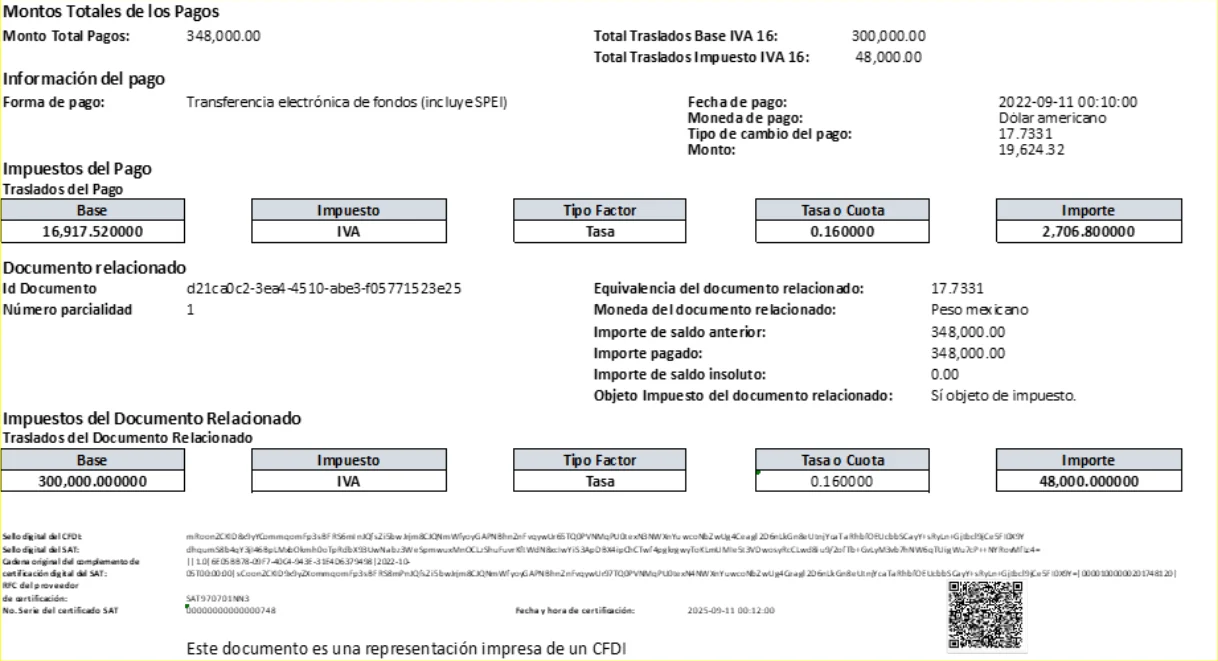
Assume a service in Mexico fully subject to the general 16% rate established in Article 1 of the VAT Law. In August, a CFDI using PPD for deferred or installment payment is issued for MXN 10,000 before VAT, MXN 1,600 VAT and a total of MXN 11,600. Nothing is collected in August. In September, the business receives MXN 5,800. This example assumes no other collections, withholdings, refunds or transactions in another currency.
| Item for this service | August | September |
|---|---|---|
| Total CFDIs issued | MXN 11,600 | MXN 0 |
| Payment received | MXN 0 | MXN 5,800 |
| Pre-VAT amount within the payment | MXN 0 | MXN 5,000 |
| VAT within the payment | MXN 0 | MXN 800 |
| Outstanding balance at month-end | MXN 11,600 | MXN 5,800 |
The September payment breaks down as follows: MXN 5,800 ÷ 1.16 = MXN 5,000 before VAT; MXN 5,000 × 16% = MXN 800 VAT. Another MXN 5,800 remains outstanding. The invoice shows MXN 1,600 VAT, but the September collection contains MXN 800. That difference is consistent with collection timing under Article 1-B, rather than a reason to change the invoice. The MXN 800 illustrates VAT associated with the collection, not the final VAT payable.
The payment complement links a payment to the invoice UUID and records information such as the payment date, installment and balance, according to the SAT description of the payment receipt. Here, that connection explains why September has a collection without a new invoice for the service. Do not extend this VAT example to income tax, or ISR: its treatment depends on the applicable tax regime.
Build an explanation rather than forcing a match
The following bridge is a recommended review control, not a legally prescribed format. Its purpose is to give each adjustment a reason and supporting evidence, rather than adding documents until the desired number appears.
- Define the comparison: separate the pre-VAT amount, VAT and total. Identify the return item and period you are reviewing.
- Start with the period's CFDIs. Where cancellations or replacements exist, identify the underlying transaction so it is not counted twice.
- Assign collections to the relevant period. Include known collections on earlier invoices and identify invoices that remain unpaid.
- Label each difference: documented payment timing, identified replacement or unresolved inconsistency. Do not classify an unsupported amount as a timing difference.
- Compare the explanation with the filed return. If an error remains, determine which document or return needs correction under the applicable current rules.
Keep the CFDI, payment evidence, corresponding payment complement and, where relevant, the connection between canceled and replacement invoices together. Add a short note stating the amount, period and reason. For example: 'MXN 5,800 collected in September against an August invoice; pre-VAT amount MXN 5,000 and VAT MXN 800.' If the complement's date or amount contradicts the documented payment, explaining a timing difference is no longer enough: the inconsistency needs to be resolved.
Do not cancel invoices to make totals match
A difference explained by collection timing does not justify canceling a real transaction. Identify the cause first and support any CFDI or return correction under the applicable rules.
Frequently asked questions
Does a difference mean there will be an audit?
That conclusion cannot be drawn from the difference. Article 42 of the Federal Tax Code establishes verification powers, but an isolated discrepancy does not establish automatic selection. Paying taxes does not remove those powers either.
Does all VAT on my purchases reduce my tax?
Not automatically. The input VAT credit conditions in Article 5 of the VAT Law must be checked. The CFDI forms part of the supporting evidence; it is not enough to establish eligibility.
When should I correct rather than explain?
When the documents confirm that the amount, period or treatment used was incorrect. If they confirm a valid timing difference, retain the explanation. If evidence is missing, resolve that gap first: an unexplained difference should not be assumed valid.