
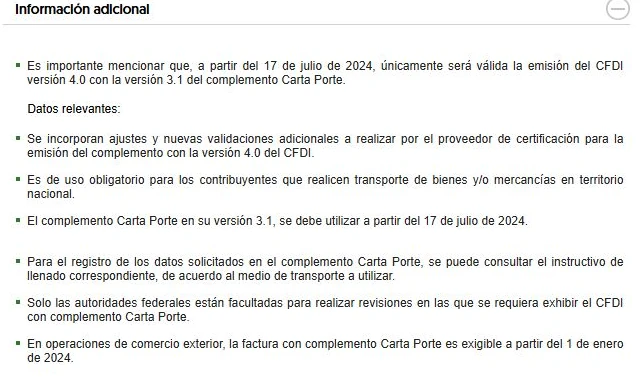
The start of July 2026 is a good time to review Carta Porte if your business moves goods, inventory, equipment, raw materials, or finished products. It’s not just an additional CFDI data point: it connects invoicing, logistics, operator, route, vehicle, client, and evidence that the transport corresponds to a real operation.
The SAT maintains a specific section for the Complemento Carta Porte, and the RMF 2026 retains rules related to CFDI for transport, income, and transport operations. For companies, the practical question is whether each trip is supported before the goods leave, not after a review or discrepancy occurs.
Critical Point
If sales, warehouse, logistics, and accounting capture data separately, Carta Porte can fail even if the invoice appears correct.
When It’s Advisable to Review Carta Porte
| Case | What to Confirm | Minimum Evidence |
|---|---|---|
| Own Goods | Origin, destination, goods transported, and person responsible for transport. | CFDI, internal order, warehouse exit, and route. |
| Contracted Freight | Transporter data, vehicle, operator, and invoiced service. | Entry CFDI, contract, or service order. |
| Delivery to Client | Relationship between order, invoice, delivery note, and goods delivered. | Order, CFDI, delivery receipt, and logistical support. |
| Transfer Between Branches | Ownership of goods and reason for movement. | Internal document, inventory, and receipt evidence. |
Risks That Appear in Audits
Problems usually arise when the XML does not match the physical operation: generic routes, poorly described goods, operators without complete data, vehicles different from those used, CFDI without clear relation to order or delivery note, or transporters issuing CFDI without internal company support.
Checklist for the Second Half of the Year
- Separate own transports, contracted freight, client deliveries, and internal movements.
- Confirm who captures data on goods, route, operator, vehicle, and permits when applicable.
- Cross-check Carta Porte CFDI against orders, delivery notes, warehouse exits, and delivery receipts.
- Verify that CFDI cancellations or substitutions do not break trip traceability.
- Keep a file per transport with XML, PDF, logistics order, and receipt evidence.
Signs That Urgent Review Is Needed
- The logistics team modifies routes or vehicles without notifying invoicing.
- The transporter delivers CFDI after the trip and no one validates the data.
- Warehouse uses internal delivery notes that do not match the XML.
- There are returns, re-shipments, or substitutions without a complete file.
Carta Porte works best when treated as an operational control, not as a last-minute invoicing formality.
— Fintax
How Fintax Can Help
Fintax can help you review the flow between sales, warehouse, transport, and accounting so that each transport has CFDI, evidence, and clear responsibilities. The goal is to reduce errors before they become cancellations, tax discrepancies, or deliveries difficult to verify.