

The 2026 annual return for legal entities in Mexico is not prepared on the day the online form becomes available. It is prepared when the company closes accounting, reconciles bank records, reviews CFDI, confirms provisional payments and documents the items behind its taxable result. If all of that is left for the last minute, the company may still submit a return, but the filing will be weak if questions or discrepancies appear later.
SAT publishes guidance for companies in its Annual Return for legal entities section. In practical search behavior, "2026 annual return for legal entities in Mexico" usually refers to the return filed in 2026 for the corresponding fiscal year. The exact date and obligations should always be confirmed against the company's tax calendar and regime.
Important clarification
This guide does not replace a tax review of a specific company. It provides a work structure so the legal entity reaches filing with reconciled numbers, documentary support and reviewed decisions.
What should be resolved before opening the form

The online form is the last part of the process, not the entire process. Before capturing or validating figures, the company should understand where each number comes from. If income, deductions, provisional payments, tax losses, profit coefficient or accounting accounts are not explained, the issue is not data entry; it is the closing process.
- Final trial balance reviewed and tied to financial statements.
- Bank reconciliations completed, including unidentified deposits and internal transfers.
- List of issued, received, cancelled and replaced CFDI for the year.
- Workpapers for income tax, provisional payments, annual adjustments and relevant indicators.
- Support for relevant deductions: contracts, deliverables, payments, business reason and evidence of materiality.
- Review of payroll, withholdings, third-party payments and related-party transactions when applicable.
- Acknowledgments, payment lines and bank proof for provisional payments.
Documents and support to organize
| Item | Why it matters | Risk if missing |
|---|---|---|
| Trial balance and financial statements | Explain the accounting base for the year. | Tax figures without clear accounting support. |
| Issued and received CFDI | Reconcile income, expenses, payroll and withholdings. | Differences against tax information. |
| Provisional payments | Support payments made during the year. | Duplicated, omitted or misapplied payments. |
| Contracts and deliverables | Support deductions and materiality. | Deductions become vulnerable under review. |
| Bank reconciliations | Explain inflows, outflows and non-tax movements. | Unexplained deposits or misclassified income. |
Income review: every source should tell the same story
Income should be reviewed from three angles: invoicing, accounting and bank records. If the CFDI says one thing, the accounting account another and the bank shows unidentified deposits, the annual return can inherit discrepancies. The review should separate billed income, advances, credit notes, cancellations, substitutions and transactions that require special treatment.
The year-end cutoff also matters. Some differences come from invoices issued near closing, later collections, advances or accounting entries that were not documented well. The objective is not to force every source to look identical; it is to explain differences with sufficient workpapers.
Deductions review: a CFDI is not enough
A strong deduction does not depend only on having a CFDI. It should be related to the business activity, paid through a valid method when applicable, supported by evidence of service or delivery, internally approved and documented as a real transaction. The larger the amount, the stronger the file should be.
- Professional services: contract, scope, deliverables, report or work evidence.
- Purchases and inputs: order, receipt, CFDI, payment and relationship with income.
- Recurring expenses: internal policy, invoices and business justification.
- Payroll: stamped CFDI, payments, incidents, withholdings and bank reconciliation.
- Assets: acquisition support, use, depreciation and accounting record.
Provisional payments and tax losses
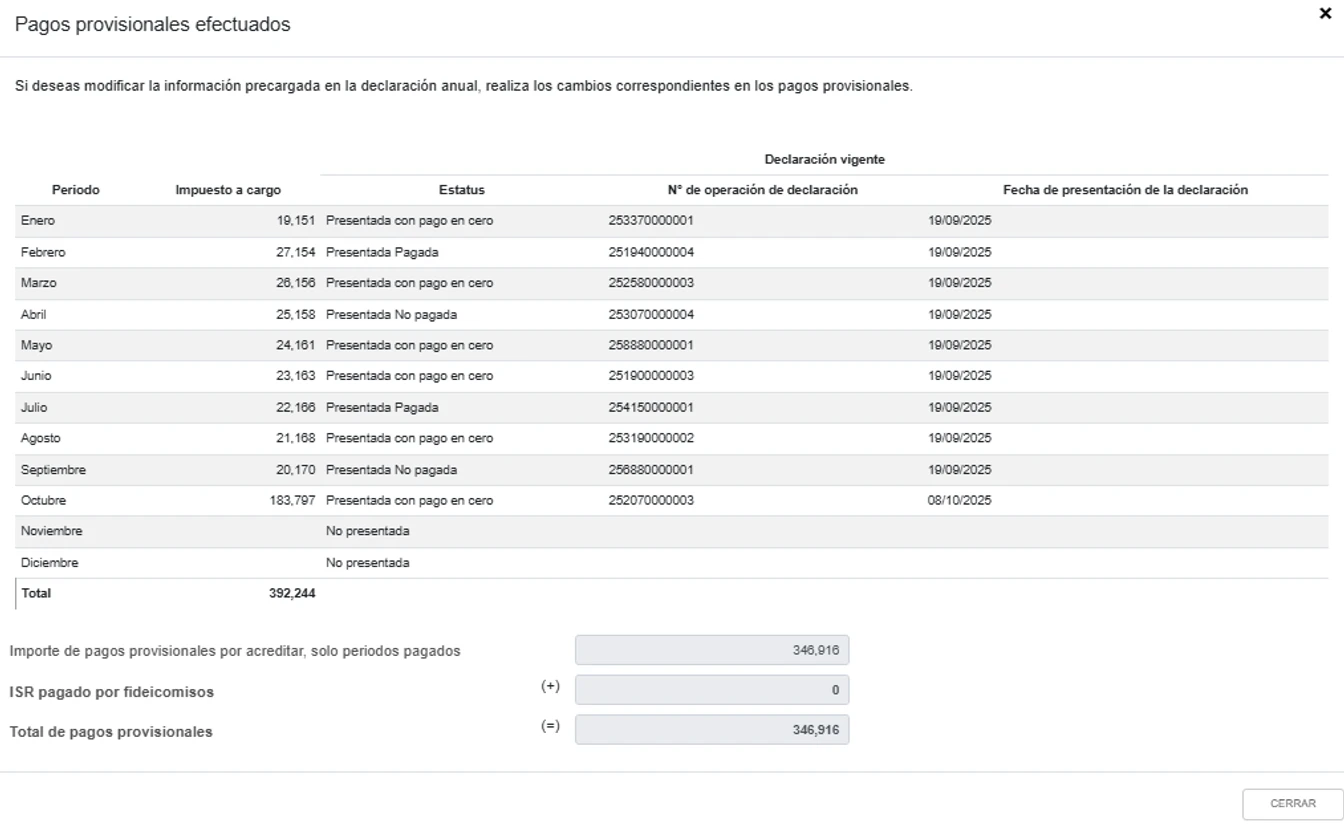
Provisional payments should be reviewed against acknowledgments, payment lines, bank records and accounting entries. A common mistake is taking the total from accounting without confirming that each payment exists and belongs to the correct period. If the legal entity applies tax losses, the company should document origin, fiscal year, remaining balance and amount applied.
| Item | Control question |
|---|---|
| Provisional payments | Does the amount match acknowledgment, bank and accounting records? |
| Profit coefficient | Is it supported by the correct fiscal year? |
| Tax losses | Is there a workpaper by year and applied balance? |
| Withholdings | Do CFDI, payments and returns match? |
Common errors to fix before filing
- Cancelled invoices without a clearly identified replacement CFDI.
- Bank deposits recorded as income without reviewing their real origin.
- Expenses with CFDI but no evidence of materiality or business reason.
- Provisional payments recorded in a different period than the acknowledgment.
- Payroll CFDI that do not match bank payments or withholdings.
- Unexplained differences between financial accounting and tax calculation.
- Trying to solve everything inside the form instead of closing workpapers first.
Recommended work calendar
| Timing | Recommended work |
|---|---|
| 4 to 6 weeks before | Close trial balance, bank reconciliations and CFDI list. |
| 3 weeks before | Review income, deductions, payroll and provisional payments. |
| 2 weeks before | Document differences and prepare final workpapers. |
| 1 week before | Management review, tax validation and filing authorization. |
| After filing | Store acknowledgment, return, attachments and support folder. |
Signs the company is not ready yet
A company may think it is ready because the trial balance exists and portal access works, but that is not enough. If relevant figures still depend on verbal explanations or scattered files, it is better to pause and close the evidence. Filing a weak annual return quickly may save a few days, but it usually creates more work when discrepancies appear.
- Bank balances do not match reconciliations or there are unidentified deposits.
- The largest deductions lack contract, deliverable, payment or materiality evidence.
- Provisional payments are not tied to acknowledgments and bank proof.
- There are cancelled or replaced CFDI without a clear relationship.
- Stamped payroll does not match accounting, bank records or withholdings.
- Management has not reviewed the taxable result or expected payment flow.
How to document tax decisions
Not every tax decision has an automatic answer. Some items require judgment: deductions with partial support, year-end income cutoffs, advances, tax losses, accruals or reclassifications. In those cases, leave a decision note: what was reviewed, what documents exist, what criterion was applied, who approved it and what residual risk remains.
Practical case: relevant deduction with incomplete support
If the company has a material deduction for services and only keeps the CFDI, the file is incomplete. Before filing, it should gather contract, order or approval email, evidence of the deliverable, bank payment and an explanation of how the service relates to business activity. If part of the support is missing, the decision should not be hidden. It should be documented, risk should be evaluated and the company should decide whether to deduct, adjust or request additional documentation.
Frequently asked questions
Does the 2026 annual return refer to fiscal year 2026?
Not necessarily. In common searches, the phrase usually refers to the return filed in 2026. The relevant fiscal year, deadline and obligation must be verified according to the company's tax regime and official calendar.
What if SAT preloaded information is different?
The difference should be investigated before filing. It may come from CFDI, cancellations, withholdings, provisional payments or accounting records. Filing without explaining differences increases the likelihood of later clarification work.
When should a company request support?
Support is recommended when there are material discrepancies, tax losses, large deductions, unusual operations, related parties, regime changes or missing reconciliations. In those cases the issue is not only filling out a form.
How Fintax can help
Fintax can support the accounting close, CFDI review, reconciliations, workpapers and preparation of the annual return. The goal is for the company to file with a clear fiscal file, not with unresolved questions.
Close the accounting decisions before filing
Create a final list of estimates, provisions, non-deductible items, related-party balances and prior-year adjustments. Each item should have an owner and supporting document. Filing should be the result of those decisions, not the moment when the team first discovers them.