

The annual return filed by individuals in April 2026 covers fiscal year 2025. If you missed that deadline, first check whether you were required to file. If you already filed, compare the submitted return with your records before deciding whether it needs an amendment.
Reconcile before opening the annual return
Prepare a compact worksheet with income CFDI, deductions, withholdings, provisional payments and unresolved differences before entering the portal. The preloaded information is a starting point, not a substitute for reviewing the taxpayer’s own evidence and the periods included in the calculation.
Start with the income types shown in the return. Check the amounts against your invoices, withholding records and payments before relying on the balance SAT displays.
Who was required to file
The obligation depends on income type and circumstances. Common cases include:
- business or professional income outside the RESICO annual-return relief;
- rental income;
- interest when the statutory filing conditions are met;
- disposal or acquisition of assets;
- dividends, prizes or other income covered by the Income Tax Law;
- wages from two or more employers at the same time;
- wages from an employer that was not required to withhold Mexican income tax;
- a written request asking the employer not to perform the annual adjustment;
- annual wages above MXN 400,000, subject to the relief described below.
An employee with income from a single employer may be relieved from filing even above MXN 400,000 if all wages came from that employer, the employer issued the payroll CFDI, no income tax is payable in the annual calculation and any nominal interest did not exceed MXN 20,000. The relief does not apply when the employer was not required to withhold Mexican tax or when the employee stopped working before December 31.
Use the SAT page on who must file the annual return to identify the category, then confirm it against the taxpayer's actual income.
RESICO income requires a separate analysis
Rule 3.13.7 of the 2026 Miscellaneous Tax Resolution treats monthly income tax payments made by RESICO individuals as final. Those taxpayers are relieved from the annual return only for income that belongs to RESICO.
Wages and interest remain subject to their own annual calculation when a filing obligation exists. A person who left RESICO during 2025 must also apply the transition rules to determine which months and income enter the annual return.
Documents and access

Prepare:
- RFC and current tax-status certificate;
- SAT Password or valid e.firma;
- monthly and provisional return acknowledgments;
- income and payroll CFDI;
- withholding certificates;
- personal-deduction CFDI and payment records;
- annual statements for mortgage interest, retirement contributions and insurance, when applicable;
- a CLABE bank account in the taxpayer's name for a refund;
- working papers by income regime.
Keep the reports you use to check each amount and save the submitted return. You will need those versions if the portal's data changes or you later discover an error.
Review the prefilled return
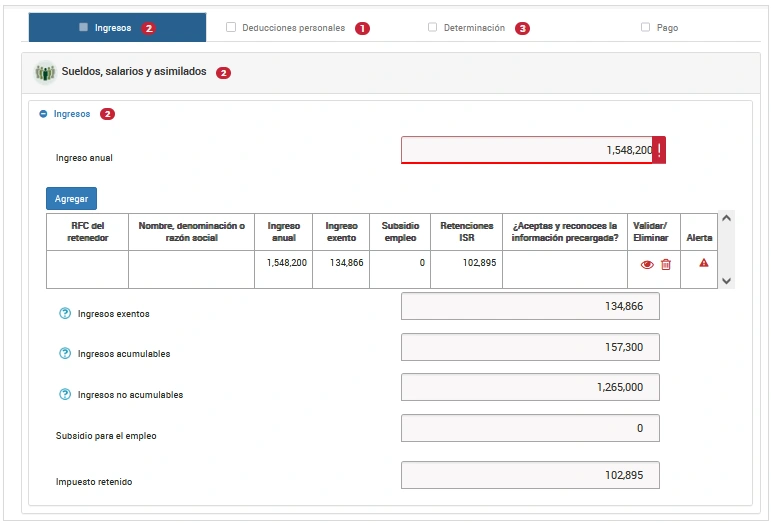

| Field | Compare it with | Frequent discrepancy |
|---|---|---|
| Wages | Payroll CFDI and employer records | Duplicate payroll or an incorrect employer. |
| Business or professional income | Issued CFDI, collections and monthly returns | Canceled invoices or a collection in another period. |
| Rental income | Lease records, CFDI and provisional payments | Missing payment or inconsistent deduction method. |
| Interest | Annual statement and withholding certificate | Nominal and real interest confused. |
| Withholding | CFDI and certificates | Missing or duplicated tax withheld. |
| Provisional payments | Monthly acknowledgments and bank receipts | Filed return without a matched payment. |
| Personal deductions | CFDI, eligible concept and payment method | Expense outside the statutory requirements. |
If a figure is wrong, identify its source before typing a replacement. The underlying CFDI, monthly return or issuer record may require correction.
Personal deductions
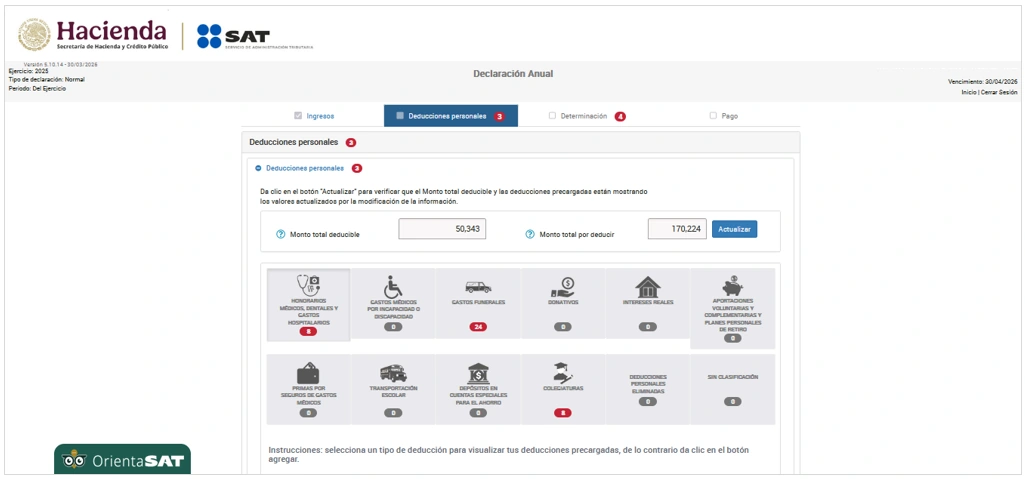
The annual return may include eligible personal deductions such as medical and dental fees, hospital expenses, certain medical insurance premiums, mortgage interest, funeral expenses, donations, school transportation when mandatory and qualified retirement contributions.
Each item has its own requirements. Check:
- correct RFC for the taxpayer and issuer;
- an eligible expense description and CFDI use;
- payment through an accepted traceable method when required;
- date within fiscal year 2025;
- statutory cap and any category-specific limit;
- absence of reimbursement or duplicate deduction.
The general cap is the lower of five annual UMA or 15% of total income, including exempt income. Certain deductions follow separate rules and may not enter that general cap.
Filing sequence
- Open the SAT annual-return service for individuals.
- Select fiscal year 2025.
- Confirm the income regimes shown for the year.
- Reconcile each income section with CFDI and working papers.
- Verify withholding and provisional payments.
- Review personal deductions and remove unsupported items.
- Confirm the taxable result and tax calculation.
- Check the CLABE if the return produces a refund.
- Submit with the authentication method required by the result and amount.
- Download the acknowledgment and, when applicable, the payment reference.
Keep the calculations used for submission. If an invoice is corrected later, compare the change with the filed return to see whether an amendment is needed.
Refunds in 2026
The automatic-refund facility for fiscal year 2025 could be requested through July 31, 2026. The authentication method depended on the refund amount and CLABE:
| Refund requested | Authentication rule |
|---|---|
| Up to MXN 10,000 | Password could be used. |
| MXN 10,001 to 150,000 with a preloaded CLABE | Password could be used. |
| MXN 10,001 to 150,000 with a different CLABE | e.firma was required. |
| More than MXN 150,000 | A separate refund request through FED was required. |
The automatic facility does not guarantee approval. SAT may request information, approve only part of the amount or route the taxpayer to the formal refund procedure.
If you did not request an automatic refund by July 31, check which refund procedure now applies and the time limit for claiming it. Submitting the same return again will not reopen the automatic-refund window.
Paying tax due in installments
Individuals could elect up to six monthly installments only if the annual return was filed on time in April 2026 and the first installment was paid during that month. The final installment had to be paid by September 30, 2026.
The option does not apply to tax arising from RESICO, controlled foreign entities or the sale of shares on a stock exchange. A late return filed after April does not gain access to the installment option under this facility.
Late filing or amendment
If the April deadline was missed:
- confirm that the taxpayer was required to file;
- reconstruct the 2025 income and deductions;
- calculate tax, inflation adjustment and surcharges when applicable;
- file through the correct SAT service;
- pay with a valid reference;
- retain the acknowledgment and bank receipt.
If a filed return contains an error, identify whether an amended return is needed. Record the reason for the change and compare the original and amended results. Do not submit repeated amendments without resolving the source data.
Common errors
| Error | Effect |
|---|---|
| Treating the filing year as the fiscal year | The wrong period is reviewed. |
| Applying the RESICO relief to all income | Wages, interest or post-exit income may be omitted. |
| Accepting every prefilled figure | Canceled or duplicated CFDI can distort the result. |
| Claiming unsupported deductions | Refund delay, rejection or adjustment. |
| Ignoring provisional payments | Tax due is overstated. |
| Using a CLABE owned by another person | Refund cannot be deposited correctly. |
| Keeping only the acknowledgment | The calculation cannot be reconstructed. |
Frequently asked questions
Is the 2026 return for fiscal year 2025?
Yes. The annual return filed in April 2026 reports fiscal year 2025.
Did every RESICO individual have to file?
No. Monthly RESICO income tax payments were final under rule 3.13.7, and the annual-return relief applied to income from that regime. Other income or a midyear exit may still create an annual filing obligation.
Can the automatic refund still be requested?
The special 2026 automatic-refund window ended on July 31. A pending refund must now be evaluated under the formal procedure that applies to the case.
Can a late return use the six-installment option?
No. That facility required an on-time filing in April and payment of the first installment during April 2026.
Official sources
- SAT: who must file the annual return for individuals.
- SAT: 2026 Miscellaneous Tax Resolution.
- Chamber of Deputies: Income Tax Law.
- SAT: annual-return portal for individuals.
Official links to complete the task
Open official services from a new browser tab, confirm the taxpayer and period, and save the resulting acknowledgment or evidence with the case.