
If you provide services and also receive rent or a salary, assessing RESICO from service billings alone can produce the wrong answer. Start by identifying which income sources must be combined for entry and which activities the election would cover. Resolve those questions before comparing tax costs: meeting an income limit and calculating tax are different decisions.
The limit includes compatible income sources
Publicación de InstagramMostrarOcultar
Original Fintax Instagram publication about choosing a tax regime for services alongside other income.
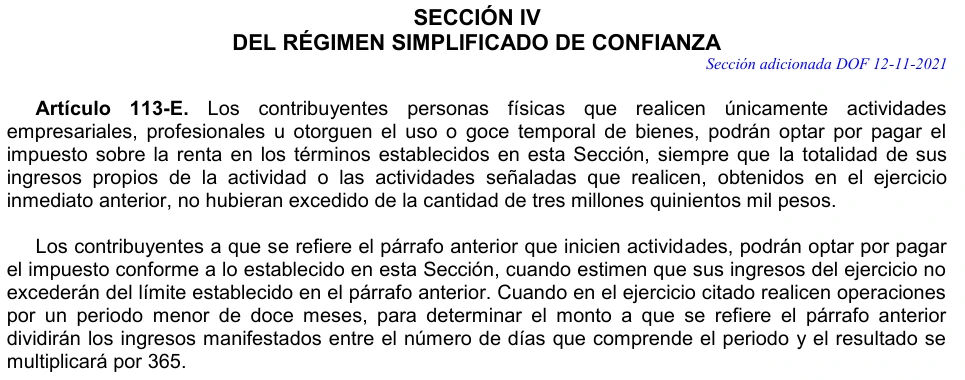
Article 113-E establishes a MXN 3,500,000 limit for individuals with business, professional or rental activities. Salary and interest income are also permitted, provided the combined income for the immediately preceding tax year from those activities and chapters does not exceed that amount and the other conditions are met. Looking at services alone therefore leaves the assessment incomplete. The source is Article 113-E of Mexico's Income Tax Law, or LISR.
As a recommended control, build an inventory by actual income source rather than bank account. A deposit might represent a service payment, rent, a loan or a transfer between your own accounts; its bank description does not determine its tax treatment. Reconcile it using CFDI tax receipts, bank statements, rental agreements, payroll receipts and interest statements, as relevant.
- Match each receipt of funds to its supporting record and the activity that generated it.
- Identify salary and interest even when they reach an account separate from the business account.
- For a loan or transfer between your own accounts, retain records establishing its origin and supporting its classification as something other than income.
- Do not automatically exclude deposits described as extraordinary: Rule 3.13.4 addresses specific cases, rather than creating a blanket exclusion.
Any review of extraordinary income should rely on the applicable case under Rule 3.13.4 of the 2026 Miscellaneous Tax Resolution, or RMF, rather than an informal description of the transaction.
Example: services fit, but combined income does not

Assume a complete preceding tax year with only three income sources, all documented and correctly classified. The amounts are gross income, excluding VAT where relevant; they are not an indiscriminate total of bank deposits. The supporting-record column identifies useful evidence for checking classification, rather than additional entry requirements. All amounts below are in Mexican pesos.
| Source | Annual income | Records to review | Treatment for the limit |
|---|---|---|---|
| Professional services | MXN 2,400,000 | CFDI receipts and collection records | Included in combined income |
| Rental income | MXN 400,000 | Agreement, CFDI receipts and collections | Included in combined income |
| Salary | MXN 800,000 | Payroll CFDI receipts | Added for this eligibility test |
| Total | MXN 3,600,000 | Reconciliation of all three sources | Exceeds MXN 3,500,000 by MXN 100,000 |
Although services total MXN 2,400,000, combined income reaches MXN 3,600,000. On these assumptions, the income criterion for entering RESICO under Article 113-E is not met. Business expenses are not subtracted to turn this comparison into a profit test. The example assesses the limit; it does not calculate income tax.
If salary were MXN 400,000, with the other two amounts unchanged, the total would be MXN 3,200,000. That would pass the amount test alone. It would not establish full eligibility: the other conditions and exclusions in Article 113-E still require review, including the exclusion concerning partners or shareholders and its narrow exceptions. If an exclusion applies, there is no reason to continue comparing RESICO tax costs.
The election covers all business activities
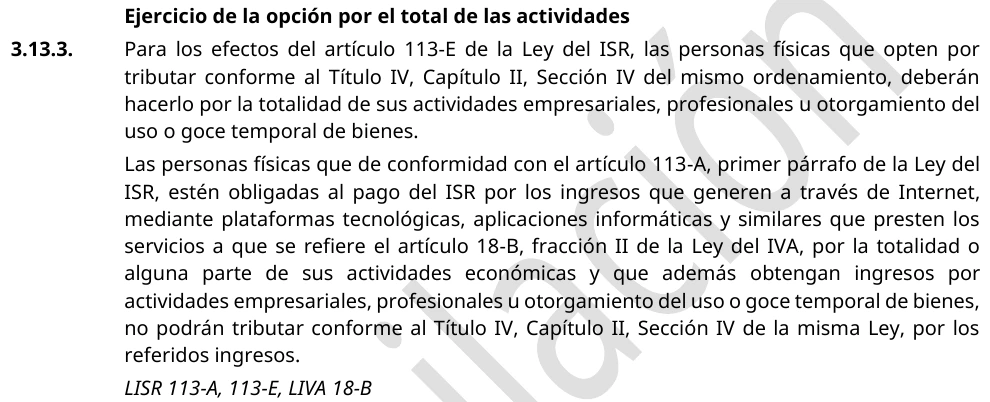
The same individual cannot choose RESICO for services while keeping rental activity or a second business activity under the general regime. The election covers all business, professional and rental activities under Rule 3.13.3. This rule about the election's scope is separate from adding salary and interest to assess the income limit.
When starting activities, check the special rule in Article 113-E: income for the period is divided by the number of days in that period, then multiplied by 365 to annualize it. Do not compare a partial period as though it were a complete year. Confirm the income and period-day inputs before applying the formula in Article 113-E.
Controls before making the election
- Complete the preceding-year reconciliation by source, amount and evidence, without counting collections twice.
- Document the combined-income test and review possible exclusions with your accountant.
- Confirm that the election covers all your business, professional and rental activities.
- Keep the entry assessment separate from the calculation applicable to each income chapter.
Frequently asked questions
Is my salary taxed at RESICO rates?
No. Adding salary to assess the limit does not change its tax chapter. Salary and interest retain their respective annual calculations when applicable, under Rule 3.13.8. Compatible income sources do not mean that every source is taxed within RESICO.
Does accepting online payments exclude me?
Not by itself. The incompatibility in Rule 3.13.3 concerns Article 113-A income involving intermediation under Article 18-B, section II, alongside other business, professional or rental income. A payment-processing fee alone does not establish that situation. Review how the income is generated and the platform's role in the transaction.