

Mexico's statutory minimum remains 15 days in 2026
Bills have proposed increasing the year-end bonus, but a legislative proposal does not change payroll. The current Federal Labor Law still requires at least 15 days and payment before December 20.
Year-end-bonus payroll fails when labor, tax, and payroll teams use different populations or figures. HR defines people and service days; payroll determines salary and proration; tax splits exempt and taxable amounts; treasury pays; and the CFDI must reconstruct the result. One control file should join all five stages.
Publicación de InstagramMostrarOcultar
Original Fintax post about statutory and contractual employee benefits in Mexico.
The labor rule in force for 2026

Article 87 of the current Federal Labor Law grants an annual year-end bonus of at least 15 days of salary, payable before December 20. An employee who does not complete the year retains a proportional right even if no longer employed on the ordinary payment date.
| Situation | Entitlement | Payment timing |
|---|---|---|
| Full year | Contract days, never fewer than 15 | Before December 20 |
| Hired during the year | Proportional amount | Before December 20 |
| Termination before December | Accrued proportional amount | In final settlement |
| Contract grants more | The higher agreed amount | Per contract without reducing the legal floor |
PROFEDET likewise describes at least 15 days, a proportional amount for less than one year, and a one-year period to claim the benefit after it becomes due. The employer's profitability does not determine the entitlement.
Start with the correct daily salary
- For fixed salary, start from the applicable ordinary daily salary.
- If the contract grants more than 15 days, use the higher benefit.
- For variable pay, identify the average required for the work arrangement.
- For commission agents and similar roles, review the applicable averaging period.
- Do not automatically substitute the IMSS contribution salary for year-end-bonus salary.
- Document salary changes and the selected criterion before running the population.
PROFEDET's FAQ distinguishes fixed and variable pay and identifies periods that count, including vacation, maternity or paternity leave, weekly rest, and occupational-risk disability. Do not deduct all absences without a legal classification.
Full-year and proportional calculations
For a full year: daily salary × bonus days. For employment covering only part of 2026: daily salary × bonus days × countable service days / 365. When salary, absences, or benefit days change, retain a segment-level calculation rather than forcing an opaque average.
| Example input | Amount |
|---|---|
| Fixed monthly salary | MXN 24,000 |
| Daily salary | MXN 800 |
| Contractual bonus | 20 days |
| Countable days in 2026 | 250 |
| Gross proportional bonus | MXN 10,958.90 |
The result is 800 × 20 × 250 / 365. This is the labor-law gross amount in the example; the payroll must still split the ISR-exempt and taxable portions and calculate withholding. The exemption never reduces benefit days or authorizes a lower gross payment.
Exempt does not mean the full bonus is tax-free
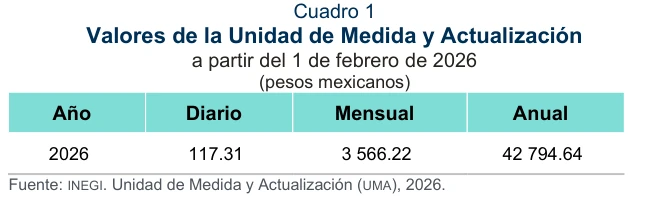
Section XIV of Article 93 of the Income Tax Law, applied with the current UMA reference, exempts a generally granted bonus up to 30 UMA. INEGI set the 2026 daily UMA at MXN 117.31 effective February 1, making the annual reference ceiling MXN 3,519.30 for a bonus paid at year-end 2026.
| Gross bonus | Maximum exempt | Taxable before withholding calculation |
|---|---|---|
| MXN 2,800 | MXN 2,800 | MXN 0 |
| MXN 10,958.90 | MXN 3,519.30 | MXN 7,439.60 |
| MXN 18,000 | MXN 3,519.30 | MXN 14,480.70 |
Do not apply a flat rate to the taxable column
The taxable portion enters the withholding procedure; it is not the tax itself. ISR depends on the applicable method and the employee's ordinary compensation.
Compare the two withholding procedures
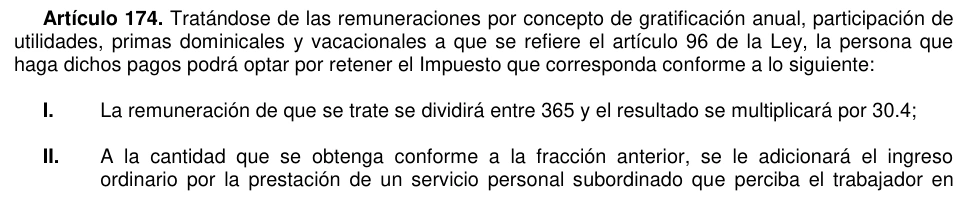
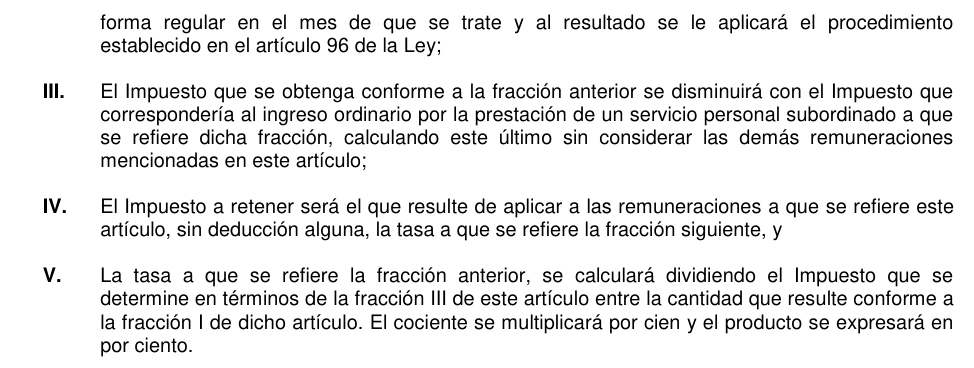
The employer may use the ordinary Article 96 procedure or the option in Article 174 of the Regulations. The optional method monthly-equivalizes part of the bonus, adds ordinary monthly income, derives a rate, and applies it to the taxable bonus.
- Run both calculations with the same taxable amount and ordinary income.
- Retain tariffs, any applicable subsidy, operations, and result by employee.
- Do not blend the year-end bonus with bonuses of a different legal nature.
- Review the effect on annual payroll ISR adjustment and excluded employees.
- Explain internally why net pay is not gross pay minus a flat percentage.
The CFDI must split taxable and exempt amounts
SAT's payroll matrix classifies the annual bonus as TipoPercepción 002 and treats it as taxable and exempt with a 30-UMA reference. The XML must match the calculation, bank disbursement, actual payment date, and employee accumulations.
| Control | Required match |
|---|---|
| Earning | Code 002 and actual concept |
| Exempt amount | Lower of bonus and applicable ceiling |
| Taxable amount | Gross minus exempt |
| ISR | Workpaper and selected method |
| Date | Payment, CFDI, and bank file |
| Net | Receipt, bank, and accounting |
Audit the population before calculation
- Hires, terminations, and rehires during the year.
- Fixed pay, variable pay, commission roles, and schedule changes.
- Disability periods, leave, and absences classified rather than merely counted.
- Contract days above the minimum and seniority-based benefits.
- Deceased employees and beneficiary payments under the applicable file.
- Advance or partial payments already made during the year.
Recommended closing calendar
| Internal date | Activity |
|---|---|
| October 31 | Freeze rules, contracts, and owners |
| November 15 | Reconcile hires, exits, salary, and absences |
| November 30 | Run a test calculation and resolve exceptions |
| First week of December | Approve ISR, CFDI, funding, and bank file |
| Before December 20 | Pay, stamp, deliver, and reconcile |
| After payment | Correct differences and review annual adjustment |
What the employee should review
- Benefit days under the contract or policy.
- Daily salary and countable period.
- Gross, exempt, taxable, ISR, and net amounts.
- Deposit against receipt and CFDI.
- Hire or termination date for a proportional payment.
- The receipt in SAT's employee payroll viewer once available.
Frequently asked questions
Has Mexico already raised the statutory minimum to 30 days?
No under the current text reviewed for 2026. Bills do not replace a reform published in the Official Gazette; the general minimum remains 15 days.
Does an employee who resigned receive a year-end bonus?
Yes. The accrued proportional amount belongs in final settlement even when employment ends before December.
Are the first MXN 3,519.30 always exempt?
That is the 30-UMA maximum under the 2026 value for a generally granted bonus. If the payment is lower, exemption cannot exceed the amount actually paid.
Should the employee rely only on the bank deposit?
No. Compare contract, receipt, XML, and deposit; PROFEDET can provide labor guidance when differences remain.