

When you rent out several properties, comparing the 35% deduction with each property's expenses can lead to an invalid combination. Your decision must cover your entire portfolio: properties you own outright and your co-owned interests. Article 196 of the Income Tax Law Regulations states that the option covers all properties rented out by the taxpayer, including properties held in co-ownership.
What you are actually comparing

Publicación de InstagramMostrarOcultar
Original Fintax Instagram publication about choosing rental deductions for an entire property portfolio.
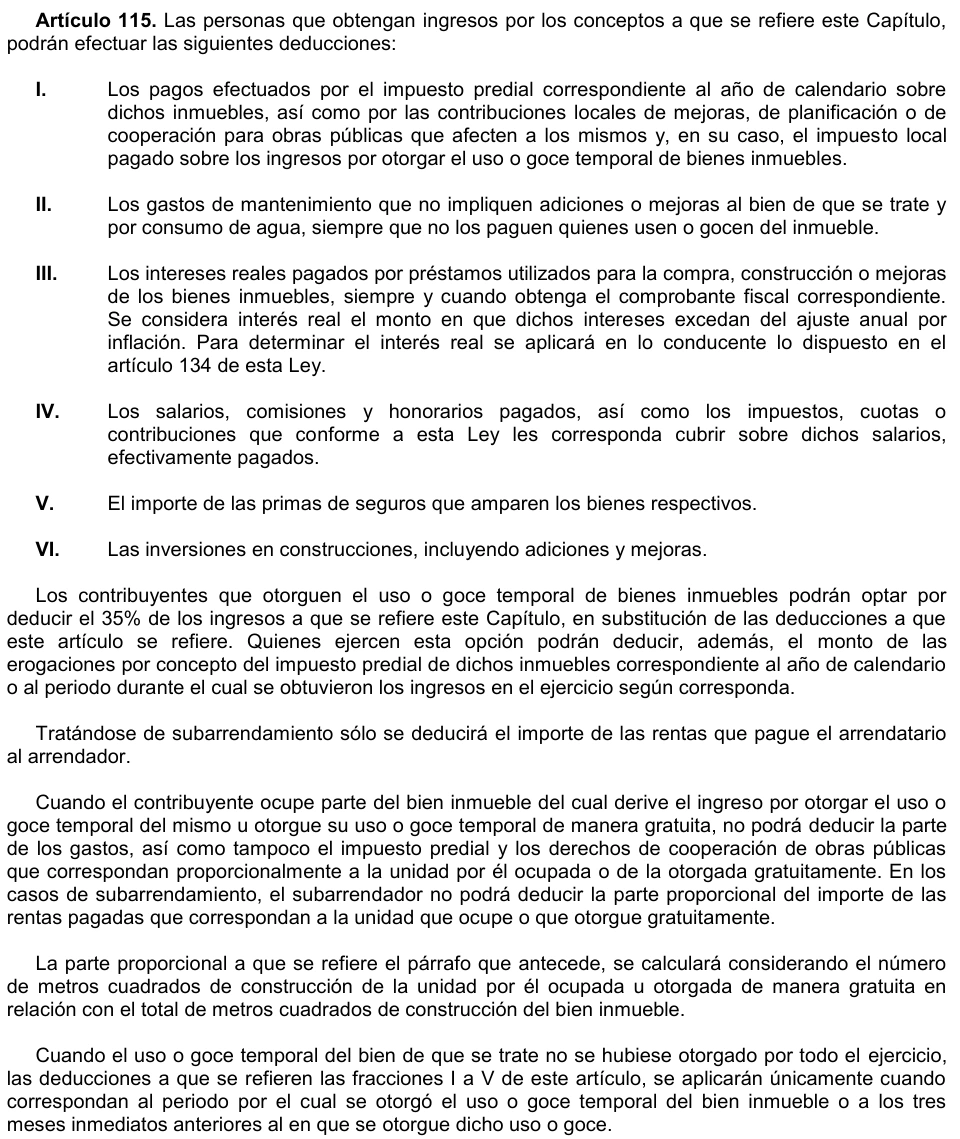
This analysis concerns ordinary rental income earned by individuals under Title IV, Chapter III of Mexico's Income Tax Law, not RESICO or lodging services. Article 115 allows a deduction of 35% of income instead of the deductions listed in that article, plus the corresponding property tax, or predial. It is an income deduction, not a tax credit worth 35% of the tax. The alternative is to claim eligible deductions under that article, with the required support and conditions (LISR, Articles 114 and 115).
The choice must be made no later than the year's first provisional return. It cannot change between provisional returns in that same year, although it can change when filing the annual return. Prepare a projection before choosing, but keep it separate from the calculation for the actual reporting period (Regulations, Article 196).
Two properties, one decision for Lucía
Assume a full year: Lucía owns 100% of property A and 50% of property B with her brother. B generates $240,000 in income and $132,000 in total deductible expenses, including $12,000 of predial. Assume all expenses are eligible, verified, and represent the year's complete deductions, with no investment deduction left to calculate. The following amounts are Mexican pesos and represent Lucía's share.
| Property | Ownership share | Lucía's income | Verified deductions, including predial | Lucía's predial |
|---|---|---|---|---|
| A | 100% | $120,000 | $28,000 | $8,000 |
| B | 50% | $120,000 | $66,000 | $6,000 |
| Her portfolio total | All of A and half of B | $240,000 | $94,000 | $14,000 |
Using documented expenses, Lucía deducts $28,000 + $66,000 = $94,000. Under the optional method, she calculates $240,000 × 35% = $84,000, then adds $14,000 of predial, producing a $98,000 deduction. Predial is already included in the first method's $94,000; adding it again would double-count it. This comparison follows Article 115 of the LISR.
| Valid method for the whole portfolio | Annual deduction | Income less deductions |
|---|---|---|
| Documented expenses | $94,000 | $146,000 |
| 35% plus predial | $98,000 | $142,000 |
The difference is not income tax savings
The $4,000 difference is in income less deductions, not $4,000 of tax saved. This annual example supports planning the choice; it is not a monthly calculation and does not determine final income tax.
Using 35% plus predial for A and documented expenses for B to obtain a $116,000 deduction would not be valid. That combination violates the portfolio-wide choice in Article 196 of the Regulations. Here, 35% plus predial produces the larger total deduction, but it will not always do so.
Co-ownership: collecting rent does not change your share
Receiving B's entire rent deposit does not make all $240,000 Lucía's personal income. Each co-owner files provisional and annual returns for their proportional income and deductions. Her brother has $120,000 of income and $66,000 of documented deductions in this example; he must assess his own portfolio rather than automatically adopting Lucía's choice (Regulations, Articles 145 and 196).
Co-ownership requires a common representative for the obligations in Article 92, including keeping books, issuing tax receipts, and collecting documentation; noncompliance carries joint and several liability. Article 199 assigns CFDI issuance to that representative. Coordinating these receipts helps prevent owners from documenting incompatible versions of the same payment (LISR, Article 92; Regulations, Article 199).
Recommended controls before choosing
- Confirm ownership and percentages against property documents. Prepare a statement allocating income, expenses, and predial.
- Reconcile gross rental receipts excluding VAT against CFDI and deposits. Identify money collected on the other co-owner's behalf.
- Gather expense and predial evidence for every property. Give each co-owner copies and check that predial has not been counted twice.
- Compare both methods using period records and a separate annual projection. A major repair does not permit an arbitrary change in provisional returns.
- Keep a dated worksheet recording the year, chosen method, and comparison. Retain documented-expense records to reassess the alternative at annual filing without deleting the earlier file.
These are recommended operational controls, not a legally prescribed file template. The rules governing the option's scope, timing, and consistency come from Article 196 of the Regulations.
Frequently asked questions
Must all co-owners choose the same method?
Co-ownership alone does not impose an identical portfolio-wide choice. Each person evaluates all their rented properties and ownership interests (Regulations, Articles 145 and 196).
Can I switch after an expensive repair?
Not in provisional returns for the same year. You may reassess and change the option when filing the annual return, retaining support for the comparison (Regulations, Article 196).