

You do not need to ‘leave’ the bureau—you need an accurate report
A credit file exists because a provider reported credit or service history. The objective is for identity, accounts, balances, dates, and payment behavior to describe what actually occurred.
Reviewing Mexico's Special Credit Report before applying gives time to document errors. The audit starts with names, addresses, accounts, inquiries, and balances—not the score. One unknown account can be more important than the rating.
Publicación de InstagramMostrarOcultar
Original Fintax post on Mexico's credit-information bureaus.
Credit bureau and financial-entity bureau are different
CONDUSEF explains that Buró de Crédito and Círculo de Crédito are authorized credit-information companies that compile histories. The government Buró de Entidades Financieras instead compares providers, complaints, sanctions, fees, and products.
| Record | Contains | Use |
|---|---|---|
| Special Credit Report | Identity, addresses, accounts, payment, inquiries | Audit your file |
| Score | Separate risk estimate | Reference, not a substitute for the file |
| Financial Entity Bureau | Provider performance and products | Compare institutions |
| Account statement | Provider transactions and balance | Prove one discrepancy |
Obtain it through the official route

CONDUSEF's August 2025 guidance states that one report per year may be requested free through the official Buró de Crédito or Círculo de Crédito portal. Type the address yourself and avoid a middleman promising deletion.
- Use your own email and device; do not share authentication answers.
- Have contracts or statements available so verification is not a guess.
- Download the full file and record issue date and reporting company.
- Do not post screenshots; the report contains identity-sensitive information.
Four-pass audit
| Pass | Review | Alert |
|---|---|---|
| Identity | Name, RFC, birth data, addresses | Alias or address never used |
| Accounts | Provider, partial account, opening, type | Credit you do not recognize |
| Performance | Balance, payment, delinquency, closure, update | Paid account still past due |
| Inquiries | Who accessed the file and when | Recent application you did not make |
Label each item correct, stale, incorrect, or unknown. Do not mix an old address, wrong balance, and identity-theft account into one story. Each disputed record needs its own facts, requested correction, and evidence.
Evidence file per disputed record
- Complete report and page containing the item.
- Identification and current address evidence.
- Contract, statement, payment, payoff letter, or provider case number.
- Timeline of opening, payments, closing, and prior contact.
- Exact request: correct balance, date, status, identity, or remove an account never contracted.
- For identity concerns, evidence of prompt product denial and access protection.
Filing the dispute
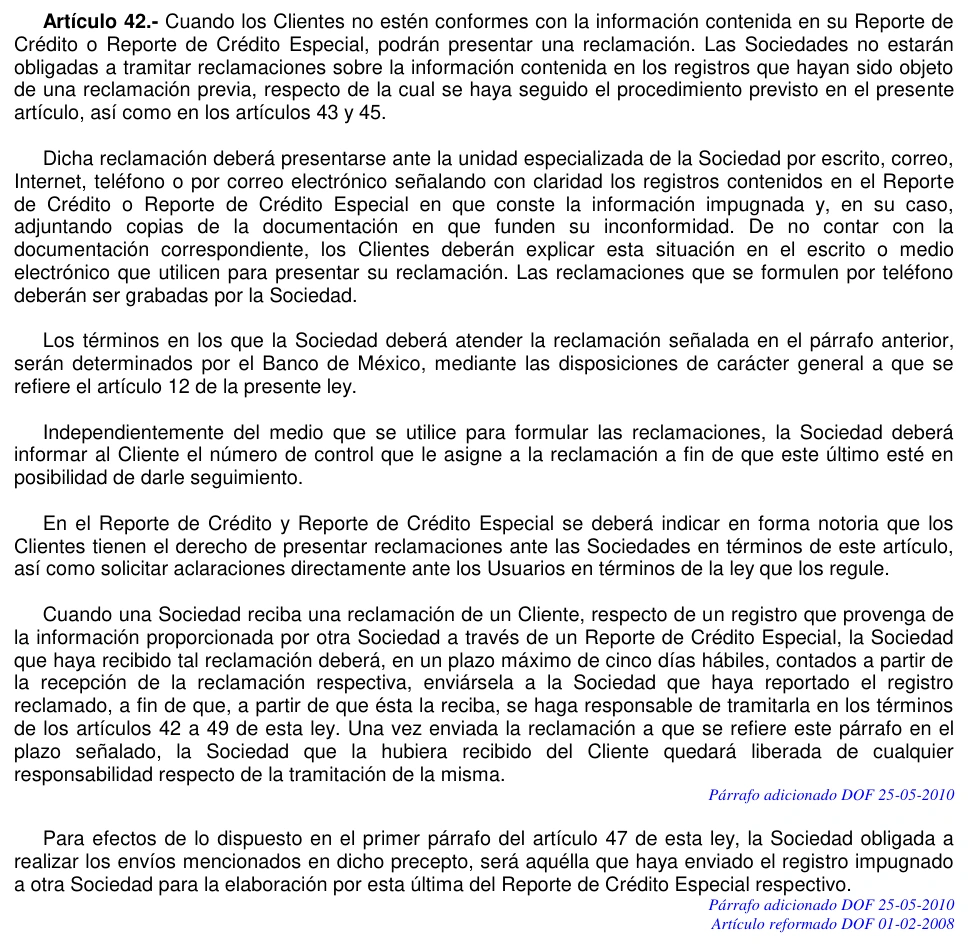
Mexico's Credit Information Companies Law permits a dispute to the company's specialized unit in writing, online, by telephone, mail, or email. Identify the disputed records clearly and attach evidence; if evidence is unavailable, explain that fact.
| Field | Useful formulation | Avoid |
|---|---|---|
| Record | Provider, partial account, report page | “My whole report is wrong” |
| Fact | Displayed value and correct value | Undated opinion |
| Evidence | Document and relevant portion | Unrelated file dump |
| Request | Exact correction requested | Only asking for a higher score |
| Contact | Email and phone you control | Third-party channel |
CONDUSEF says a credit-history clarification should receive a response within 29 business days. Retain the case number and report version. If the provider is a financial institution and the issue remains unresolved, first obtain its clarification number and review the current CONDUSEF complaint route.
A dispute does not erase valid debt
Use it for inaccurate or unrecognized information. If the account and delinquency are real, pay, negotiate, or document the agreement. An unsupported dispute does not convert a valid record into an error.
Unknown account response
- Stop new applications and secure related email and financial access.
- Call the provider at its official number and deny the product in writing.
- Ask what identity, channel, address, and disbursement account were used.
- Dispute the file item with the provider case number.
- Review the other authorized report and all recent inquiries.
- Assess a report to authorities and institutional support based on the evidence and fraud type.
Time-based deletion is not debt forgiveness
Retention periods depend on the amount in UDIs and legal conditions. CONDUSEF summarizes one-, two-, four-, and six-year periods for certain ranges, with exceptions for amount, litigation, or fraud. Removal from a credit file does not automatically establish civil prescription, forgiveness, payoff documentation, or an inability to collect.
Full payment, restructuring, and settlement produce different histories
| Outcome | Evidence | Future reading |
|---|---|---|
| Full payment | Zero balance and payoff letter | Original agreement fulfilled |
| Restructuring | New agreement, calendar, allocation | Modified obligation |
| Discounted settlement | Written offer before and payoff after | Loss to provider may be reported |
| Unknown account | Case numbers, dispute, resolution | Identity or reporting correction |
Do not pay a discounted settlement solely on a collector's call. Verify the receiving account, agreement, amount, deadline, remaining balance, and payoff letter. A promise to ‘clean the bureau’ without the provider is a fraud signal.
Pre-application calendar
| Timing | Action |
|---|---|
| 45–60 days before | Obtain reports and classify discrepancies |
| Same day | Deny urgent unknown accounts or inquiries |
| Week 1 | File separate evidence-backed disputes |
| During response | Avoid unnecessary multiple applications |
| At resolution | Download a new report and verify every corrected field |
| Before applying | Compare product and affordability, not score alone |
Frequently asked questions
Does being in the bureau mean a blacklist?
No. A file records credit and payment behavior. Each lender applies its policy and reviews more than the mere existence of a report.
Does payment update immediately?
The provider reports under its applicable cycle. Keep payment and payoff evidence, review the next file, and dispute a persistent error.
Does checking my own report lower the score?
Obtaining your own Special Credit Report is a control query. Distinguish it from lender inquiries tied to credit applications.
Can a repair company delete accurate information?
It should not promise that. The provider and credit-information company update records under law and the dispute process.
Official sources
Review CONDUSEF's credit-history guidance, its explanation of the Financial Entity Bureau, the Credit Information Companies Law, and the financial complaint route.