

Reporting does not mean automatic tax
A financial institution reporting monthly cash deposits above MXN 15,000 does not turn every peso into taxable income or revive Mexico's former cash-deposit tax. It does make the source, tax treatment, and record of each credit essential.
In 2026, banks and other covered institutions continue providing SAT with information about cash deposits. The threshold is only one part of the rule: taxpayers need to know what counts as cash, how multiple accounts at the same institution are aggregated, and whether their evidence tells the same story as the bank statement.
Publicación de InstagramMostrarOcultar
Original Fintax post about bank reporting of cash deposits to Mexico's SAT.
What the financial institution reports
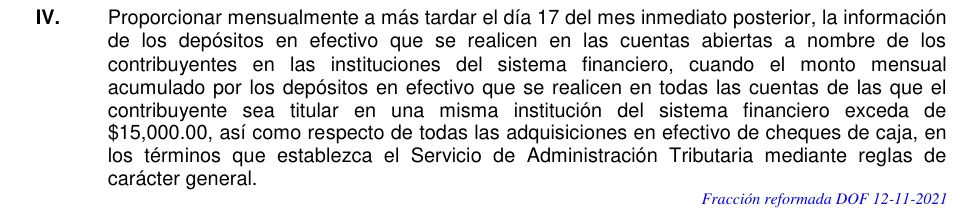
SAT's official cash-deposit information-return procedure covers cash deposits made to all accounts held by a person at the same institution when the monthly aggregate exceeds MXN 15,000. It also covers every cash purchase of a cashier's check.
| Element | Practical rule | It does not mean |
|---|---|---|
| Threshold | More than MXN 15,000 accumulated in the month | A monthly income-tax allowance |
| Aggregation | All accounts of the same holder at one institution | A separate MXN 15,000 threshold per account |
| Frequency | Institution may report monthly | Customer files IDE-M |
| Cashier's check | Cash-funded purchase is reported | Only purchases above MXN 15,000 apply |
| Reported data | Bank movement and ownership | Final tax classification of the source |
The obligation is tied to Article 55(IV) of Mexico's Income Tax Law. SAT also states that institutions using monthly reporting file by the tenth day of the following month. This is an obligation of the financial system, not an extra return the account holder submits for every deposit.
What counts as a cash deposit
- Mexican currency physically delivered for credit to an account.
- Foreign currency physically delivered for credit to an account.
- Cash delivered by the holder or another person into the holder's account.
- Cash-funded purchases of cashier's checks.
What does not enter that definition
SAT excludes electronic transfers, account-to-account transfers, negotiable instruments, and other documents or systems agreed with financial institutions, even when the sending and receiving accounts are at the same institution.
| Movement | Cash for this report? | Control still required |
|---|---|---|
| Customer SPEI | No | CFDI, receivable, and income |
| Transfer between own accounts | No | Origin and destination statements |
| Deposited check | No under this definition | Instrument and payment cause |
| Banknotes deposited at a branch | Yes | Source and record |
| Banknotes deposited by a customer | Yes | Sale, CFDI, and collection |
| Cash purchase of cashier's check | Yes | Beneficiary and purpose |
The threshold does not decide whether money is taxable
Tax treatment follows the legal and economic cause. A cash sale may be income even when the deposit is below MXN 15,000. A transfer between a taxpayer's own accounts may exceed the amount without creating new income. A loan may not be income, but calling a deposit a loan does not prove it.
| Claimed source | Minimum evidence | Risk if missing |
|---|---|---|
| Sale or service | CFDI, order, delivery, collection, and return | Omitted income or VAT difference |
| Loan | Agreement, identity, capacity, lender outflow, and receipt | Reclassification as income |
| Owner contribution | Resolution, agreement, accounts, identity, and bank trail | Unsupported equity or liability |
| Reimbursement | Original expense, policy, approval, and calculation | Untraceable credit |
| Asset sale | Ownership, contract, price, delivery, and tax treatment | Incorrect income or gain |
| Own-account transfer | Both statements and matching ownership | Duplicate income or unexplained credit |
Mexico's Supreme Court has held that, when rebutting a presumption with a loan, the agreement alone may be insufficient. Evidence should establish substance and flow, including records showing the lender's delivery. Documentation should surround the transaction rather than being created after an inquiry.
Deposits, accounting records, and presumed income
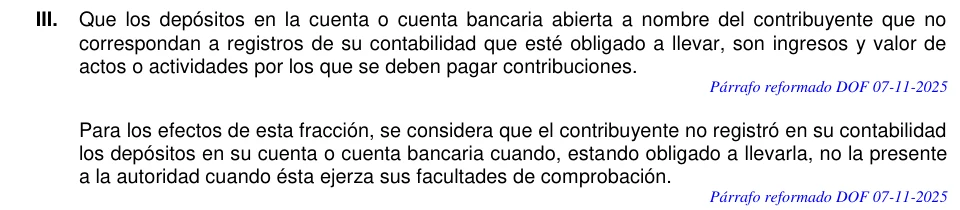
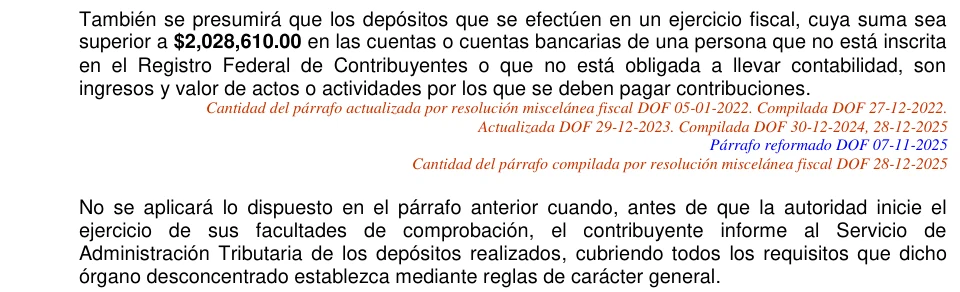
Article 59(III) of the Federal Fiscal Code allows the authority to presume that bank deposits not corresponding to required accounting records are income, subject to rebuttal. Therefore, the control should not be limited to cash crossing the reporting threshold.
- Record the deposit on the correct date and account.
- Link it to the customer, contract, CFDI, receipt, or source document.
- Separate sales, loans, contributions, reimbursements, and transfers.
- Reconcile total collections against CFDIs and period returns.
- Retain evidence of the third party delivering cash when relevant.
- Document differences and corrections before monthly close.
A monthly control that works
| Step | Work | Output |
|---|---|---|
| 1. Export | Download every account movement | Complete monthly base |
| 2. Identify | Mark cash, SPEI, check, or transfer | Entry-channel classification |
| 3. Aggregate | Add cash by institution and holder | Visible threshold |
| 4. Explain | Assign source and treatment | Deposit-to-document map |
| 5. Reconcile | Compare CFDI, sales, accounts, and returns | Open differences |
| 6. Close | Correct and archive support | Reproducible evidence file |
Do not mix three separate obligations
| Rule | Reporter | General trigger |
|---|---|---|
| Cash deposits | Financial institution | Monthly aggregate above MXN 15,000 at the same institution |
| Cash consideration | Receiving taxpayer | Cash, gold, or silver transactions above MXN 100,000 under applicable rules |
| Income return | Taxpayer | Income and tax regime, not bank channel alone |
Article 161 of the Income Tax Regulations develops the notice for consideration received in cash, gold, or silver above MXN 100,000. It is separate from the bank's MXN 15,000 information report and must be analyzed by transaction and applicable facts.
Signals to correct before close
- Repeated deposits described as loans without an identifiable lender outflow.
- Cash sales without CFDI or collection records.
- Own transfers booked as sales in one account and omitted in the other.
- Cash from multiple locations concentrated without source-level till records.
- Owner contributions without a resolution or corresponding accounting.
- Cash-funded cashier's checks without archived beneficiary and purpose.
- Differences among deposits, card terminals, platforms, CFDIs, and returns.
Do not split deposits to avoid reporting
Breaking up one transaction does not change its source and may weaken traceability. Use bank channels where practical, record income when required, and retain sufficient evidence of origin.
Reconciliation example
During October, a business receives MXN 24,600 in cash through three deposits at one bank, MXN 38,000 through customer SPEIs, and MXN 50,000 as an own-account transfer. The bank-reporting cash aggregate is MXN 24,600; the SPEIs and transfer are not cash. For tax control, however, the business reconciles both cash and SPEIs to sales and CFDIs and proves the transfer with origin and destination statements.
Frequently asked questions
Does SAT charge tax when I deposit more than MXN 15,000 in cash?
There is no automatic tax for crossing the threshold. The institution reports under the Income Tax Law; tax depends on whether the money is income and on its applicable treatment.
Is the limit applied per account?
The rule aggregates accounts held by the person at the same financial institution. Several accounts at one bank do not create separate thresholds.
Is an electronic transfer a cash deposit?
Not for this information return. SAT excludes electronic and account transfers, although their source must still be explained and recorded correctly.
Is every bank deposit income?
Not necessarily. The transaction may be a sale, loan, contribution, reimbursement, or own transfer. Economic substance, records, and evidence determine the explanation, not a label written after the fact.