
A SAT resolution assessing tax debt requires a more precise decision than paying everything or disputing everything. Some items may be accepted; others may have evidence that still needs review. The first objective is to build a file that supports separate decisions about what to pay, what to challenge and how to address security for the tax debt.
Read the assessment as separate items, not one total
Publicación de InstagramMostrarOcultar
Original Fintax Instagram publication about a SAT tax assessment or resolution.
Obtain the complete resolution, its attachments and the notification record. Identify the issuing authority, reasons, legal grounds and assessed items. Article 38 of the Federal Fiscal Code (CFF) establishes requirements for administrative acts. As a practical control, match each item to its tax period, principal tax, additional charges and evidence. A difference in the total does not, by itself, identify the problem.
- Gather returns, filing acknowledgments, bank payment receipts and CFDI tax invoices connected to the assessed items.
- Keep the resolution's amounts separate from the amounts reconstructed by your accountant.
- Mark each item as accepted, disputed or awaiting review. This working classification does not replace the legal decision.
Example: two items with different evidence
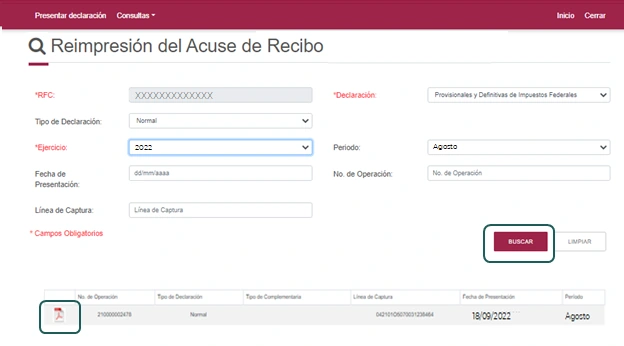
Assume a final SAT resolution separately identifies two items: 2024 income tax (ISR) of MXN 100,000 in principal and 2024 value-added tax (IVA) of MXN 40,000 in principal, each with associated additional charges. The business has an ISR return and bank receipt for a payment it believes was not recognized. Its IVA reconciliation confirms an omission involving transactions for which payment was actually collected.
| Item | Available evidence | Review question | Proposed route |
|---|---|---|---|
| 2024 ISR: MXN 100,000 plus additional charges | Return, filing acknowledgment and bank receipt | Does the payment match the assessed tax and period, and was it applied? | Verify application and evaluate a challenge with a lawyer |
| 2024 IVA: MXN 40,000 plus additional charges | Reconciliation of collections and filed return | Do the omission and additional charges match the reconstruction? | Evaluate payment or an authorization request, if eligible |
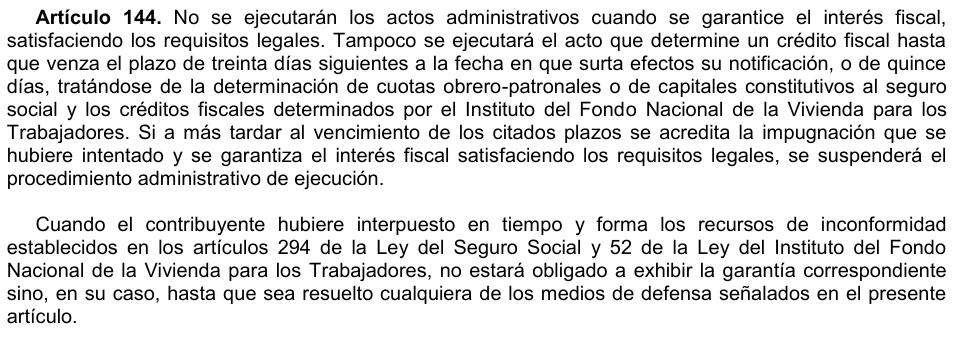
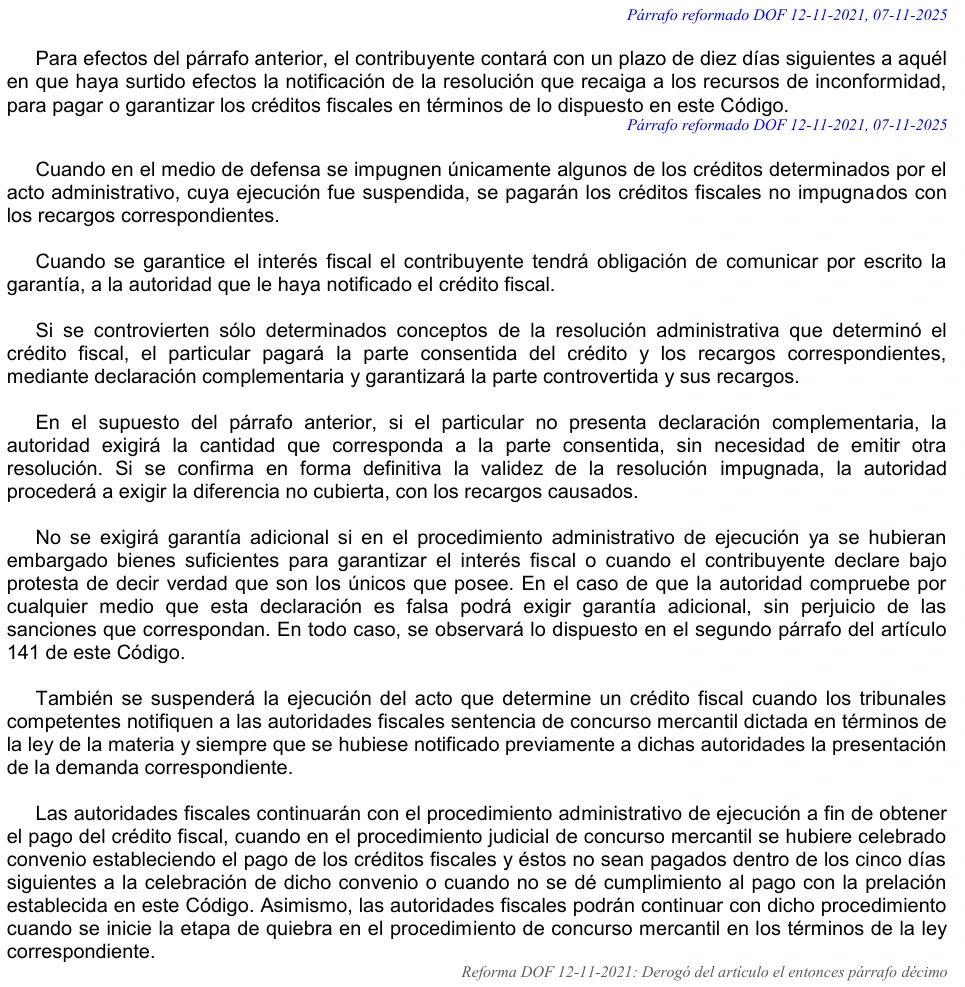
The ISR receipt does not justify automatically subtracting MXN 100,000 from the debt: its match and application must first be verified. Nor does it establish that the resolution is invalid. If only ISR is challenged and IVA is accepted, the decision must account for paying the accepted portion with late-payment charges and securing the disputed portion with late-payment charges under CFF Article 144.
Separate deadlines, challenges and security
These obligations serve different purposes. Article 65 generally allows 30 days following the date notification takes effect to pay or secure the debt and its additional charges, with the exception in Article 41, subsection II. Article 121 sets 30 days to file an administrative appeal, or recurso de revocación, except for the situation in Article 127. Whether that appeal is available must be checked under CFF Article 117.
A challenge does not automatically stop collection. CFF Article 144, applicable in 2026, governs security and suspension; the former security exemption associated with a recurso de revocación before SAT must not be relied upon. The current exception for certain timely inconformidad appeals before IMSS or Infonavit is not an exception for that SAT appeal.
Practical controls before implementing the decision
- Have the accountant reconstruct principal tax and additional charges by item, with a traceable connection to returns and receipts.
- Have the lawyer review eligibility, grounds, timing, suspension and security requirements before filing a challenge.
- Record payment or security deadlines separately from challenge deadlines. Confirm the calculation using the notification record and CFF Articles 12, 134 and 135.
- Document which items are accepted and which are disputed, together with payment capacity and the availability of security.
- Assign responsibility for filing, paying, submitting documents and checking results. Retain acknowledgments and evidence of each action.
Paying over time requires authorization
The CFF permits requests for deferred payment of up to 12 months or installments of up to 36 months, with an initial payment of 20%, subject to authorization and the conditions and exclusions in Articles 66 and 66-A. The procedure in Annex 2 of the 2026 RMF requires an application and documentation. Starting monthly deposits does not replace authorization.
As a recommended control, use the current official payment reference corresponding to the debt being paid. Save the receipt and acknowledgment, verify application with the authority and confirm closure of the item. For a partial challenge, have the lawyer first check that payment and security match the agreed separation.
Frequently asked questions
Does a clarification request stop the clock?
Do not treat it as a pause. Keep tracking payment, security and challenge deadlines while submitting evidence to clarify an item. Deadlines and suspension must be reviewed under CFF Articles 65, 121 and 144.
Can I pay one part and challenge another?
CFF Article 144 addresses partially disputed items. It requires separating the accepted portion, paid with late-payment charges, from the disputed portion, secured with late-payment charges and the applicable requirements. An arbitrary payment toward the total does not replace that separation.