
Before settling an overdue federal tax in Mexico, you need to know what makes up the balance and which documents will establish that it was paid. Tax principal, inflation adjustments, late-payment surcharges and fines are different items. A total without a breakdown makes it harder to verify the calculation or spot principal that has already been paid. Articles 17-A, 21 and 73 of the Federal Fiscal Code (CFF) provide the framework for separating those questions.
Four items that should not be confused
Publicación de InstagramMostrarOcultar
Original Fintax Instagram publication about the cost of late tax payments.
Principal is the outstanding tax. The inflation adjustment, or actualización, uses the monthly INPC for the month before payment divided by the monthly INPC for the month before the due date. No adjustment applies for fractions of a month. If the latest index has not been published, use the latest published monthly index. Calculate the factor to four decimal places; if it is below one, apply one instead. A falling index does not reduce the debt. These rules appear in CFF Article 17-A.
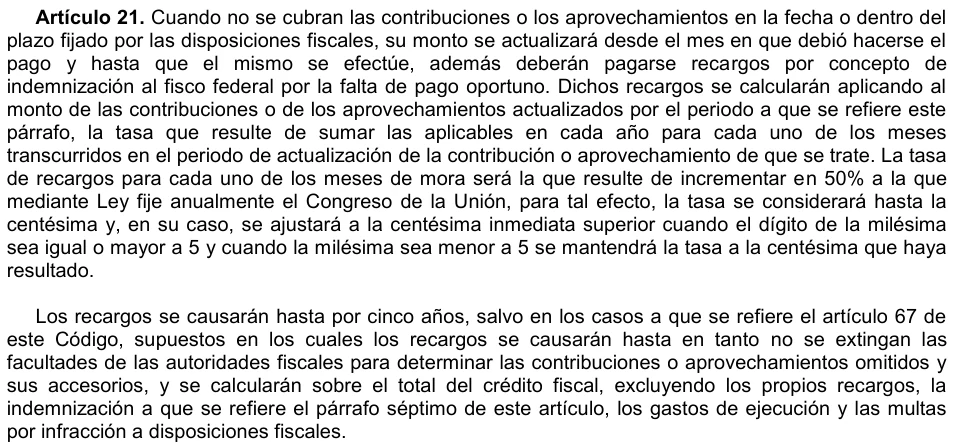
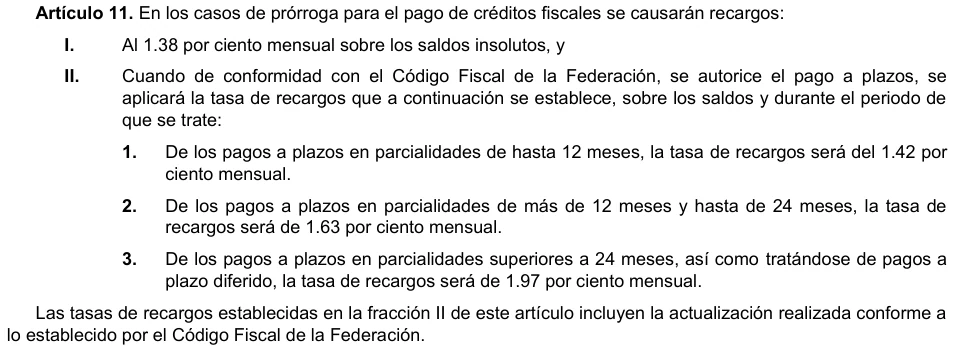
Late-payment surcharges, or recargos, apply for each month or fraction from the due date to payment. Their base is inflation-adjusted principal, excluding surcharges, fines, enforcement costs and compensation for a dishonored check. For 2026, the monthly extension rate is 1.38%; the statutory 50% increase for late payment produces 2.07% monthly. See CFF Article 21 and Article 11, subsection I, of the 2026 Federal Revenue Law. Authorized installment rates under subsection II do not apply to this calculation.
Fines require a separate assessment. CFF Article 73 provides for spontaneous compliance without a fine, subject to exceptions, including the authority having discovered the omission or notified relevant proceedings. This rule does not remove inflation adjustments or surcharges. Nor does late payment automatically create a new fine every month.
Historical example: a MXN 10,000 balance
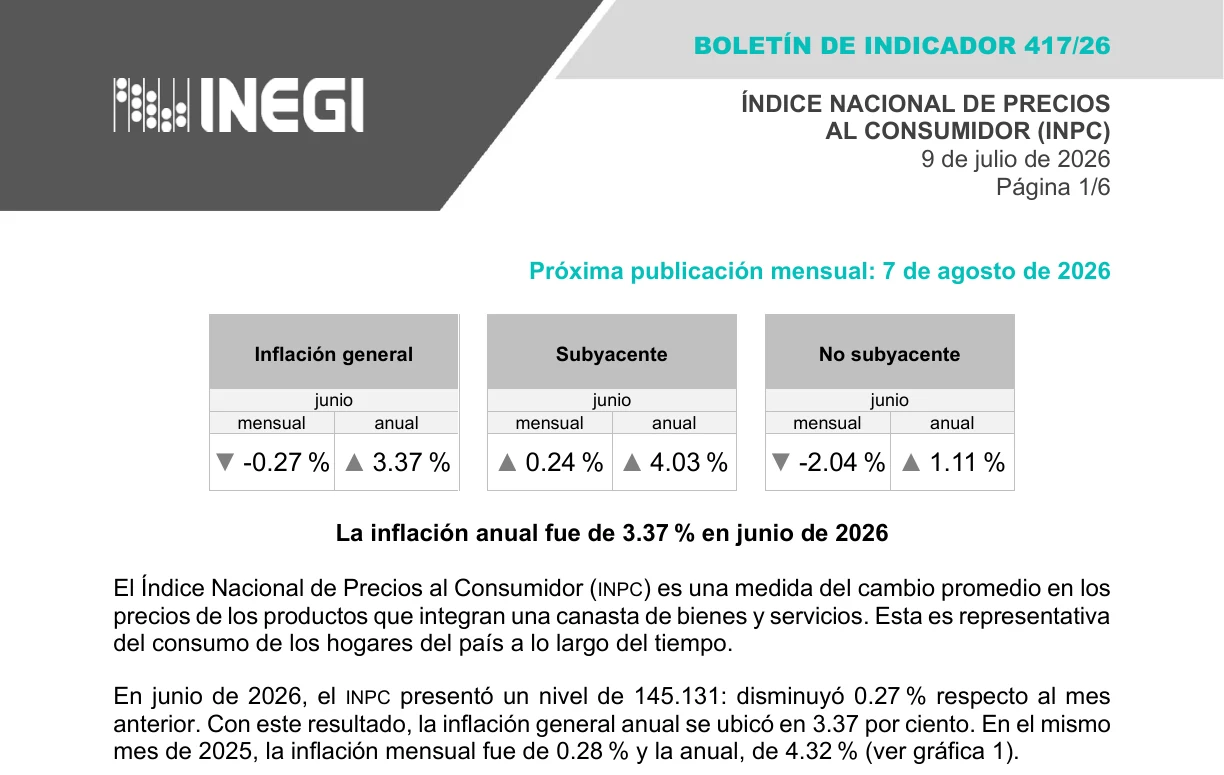
Assume self-assessed federal tax of MXN 10,000, an already verified due date of May 18, 2026, and full payment on July 20, 2026. There were no previous partial payments; the calculation includes no fine or enforcement costs. The 18th is an assumption for this case, not a general tax deadline. Whether a fine applies still requires reviewing the circumstances of spontaneous compliance.
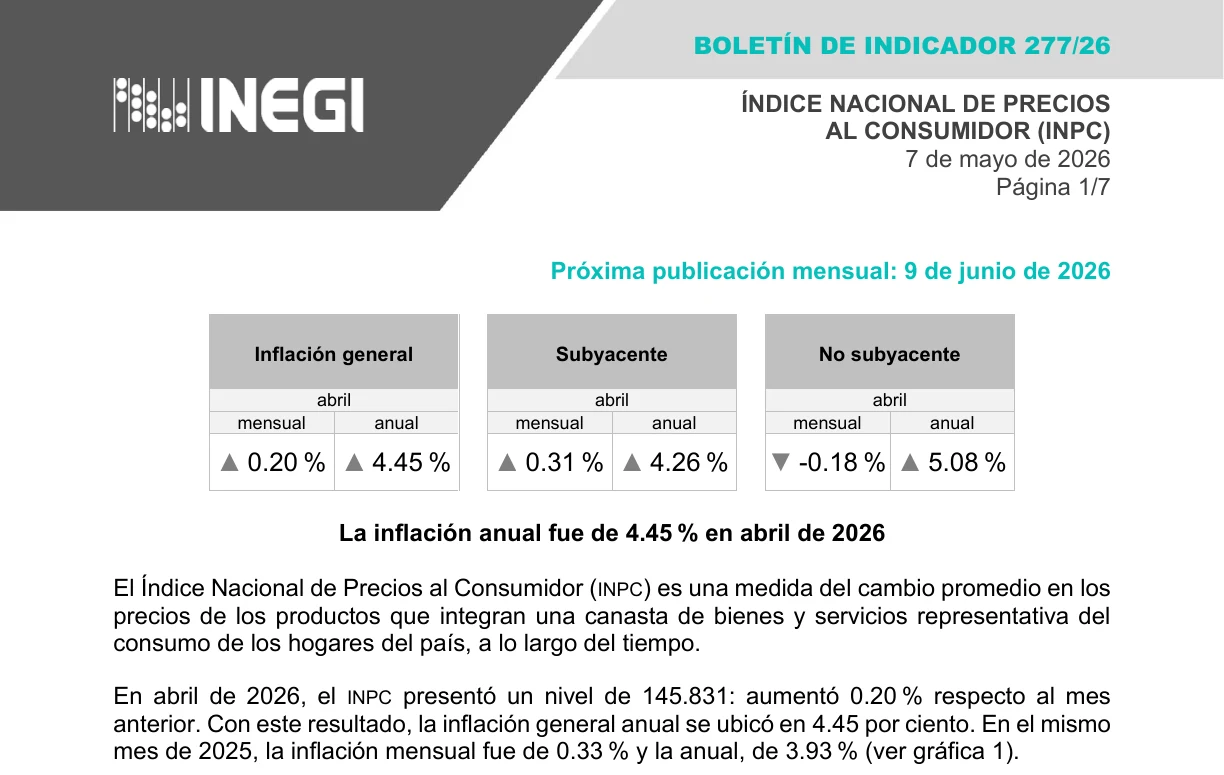
April's monthly INPC was 145.831, according to INEGI bulletin 277/26; June's was 145.131, according to bulletin 417/26. These months immediately precede the due date and payment, respectively. Use the monthly indices, not the half-month indices.
| Item | Calculation or rule | Result |
|---|---|---|
| Outstanding principal | Self-assessed tax with no previous payments | MXN 10,000.00 |
| Calculated factor | 145.131 ÷ 145.831 | Approximately 0.9952 |
| Applicable factor | Replace a factor below one with one | 1.0000 |
| Inflation adjustment | MXN 10,000 × (1.0000 − 1) | MXN 0.00 |
| Late-payment periods | May 18-June 18; June 18-July 18; July 18-20 | Two months and a fraction: three periods |
| Surcharges | MXN 10,000 × (3 × 2.07%) | MXN 621.00 |
| Example total | MXN 10,000 + MXN 0 + MXN 621 | MXN 10,621.00 |
The accumulated rate is 6.21%. Although the INPC fell between the two months, principal remains MXN 10,000 and generates MXN 621 in surcharges. The total is before any other applicable item. The third period is a fraction, but it counts for surcharges: the amount is not prorated as daily interest or restricted to business days under CFF Article 21.
Controls to settle the balance without paying principal twice
The following steps are recommended controls for preparing and checking payment, rather than substitutes for statutory calculation rules. The SAT's tax debt service is an official reference for regularization. Confirm the return and payment-reference process applicable to your tax regime and period.
- Identify the RFC, tax, regime and period. Verify the actual deadline and any applicable extension; do not assume it is always the 17th.
- Establish whether a return has already been filed or remains outstanding. Gather filing acknowledgments and previous payments before generating another return or reference.
- Set the intended payment date. Compare the official breakdown with historical monthly INPC values, applicable rates and elapsed months or fractions.
- If the payment reference has expired, update it through the official process and confirm its validity. Check that principal does not include amounts already paid.
- Keep the return, filing acknowledgment, reference and bank receipt. Match the reference and amount, and confirm that the bank debit cleared. Add calendar reminders.
Frequently asked questions
Does being one day late trigger surcharges?
Yes. One day is a fraction of a month for surcharges. If the due date and payment fall within the same calendar month, the inflation-adjustment factor is one, but surcharges still apply. These are separate mechanisms under CFF Articles 17-A and 21.
Does late payment always mean a fine?
No. Review whether compliance is spontaneous and whether an exception in CFF Article 73 applies. A possible absence of a fine does not mean that surcharges or inflation adjustments disappear.
Can I use 2.07% if the delay crosses into another year?
Not automatically. CFF Article 21 requires adding the rates applicable to the months of each fiscal year. Verify the relevant revenue law and published monthly indices; do not extend the 2026 rate or anticipate future index values.