

If you are in RESICO, your question may be what to do with an unpaid invoice or tax withheld by a customer. Preparing the monthly return means identifying those collections and withholdings. You also need a separate VAT calculation and records supporting the period's transactions.
The rules below apply to individuals in RESICO. Corporate RESICO has different ownership tests and calculations; see the guide to the tax regime for legal entities for that regime.
Who can use RESICO
Article 113-E of Mexico's Income Tax Law allows individuals to opt into RESICO for business activities, professional services, or leasing. Revenue from those activities in the prior year must not exceed MXN 3.5 million.
A new taxpayer can use an annual estimate under the same limit. If the first year covers less than twelve months, Article 113-E requires the taxpayer to annualize revenue under its formula.
| Test | What to review |
|---|---|
| Activity | Revenue must come from eligible business, professional, or leasing activities |
| Limit | Prior-year revenue and current-year collections |
| Additional income | Wages and interest may coexist if the combined limit and other conditions are met |
| Ownership interests | Companies, related parties, and exceptions under the law and tax rules |
| Tax status | Active RFC, e.firma, Tax Mailbox, and applicable compliance duties |
Being a shareholder or company member usually prevents RESICO, although tax rules provide specific exceptions. Co-ownership is not an automatic exclusion either. Current rules allow some cases subject to joint and individual revenue tests. Both situations require a document review.
Other excluded taxpayers include nonresidents with a permanent establishment in Mexico, people receiving income under preferential tax regimes, and recipients of certain deemed-salary payments listed in Article 94.
How to calculate the monthly income tax

RESICO applies income tax to CFDI-supported revenue collected during the month. VAT is excluded and expenses do not reduce this income tax base. The applicable rate depends on the amount collected:
| Monthly revenue collected | Income tax rate |
|---|---|
| Up to MXN 25,000.00 | 1.00% |
| Up to MXN 50,000.00 | 1.10% |
| Up to MXN 83,333.33 | 1.50% |
| Up to MXN 208,333.33 | 2.00% |
| Up to MXN 3,500,000.00 | 2.50% |
This is not a progressive bracket calculation. The taxpayer selects the row for total monthly collections and applies that rate to the full amount before VAT. Creditable income tax withholding is then applied.
Collection and withholding example
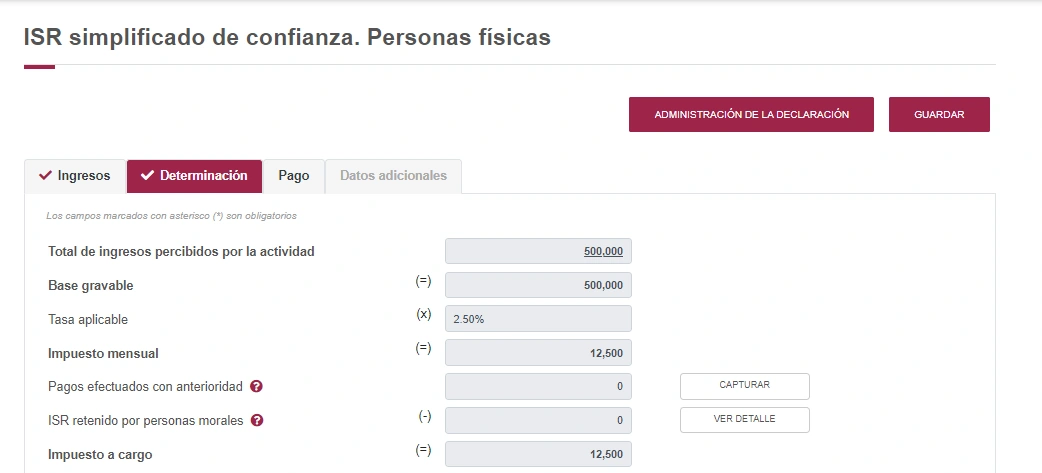
A consultant in RESICO collects MXN 40,000 plus VAT from a company. The table rate is 1.10%, so monthly income tax before credits is MXN 440.
Under Article 113-J of the Income Tax Law, the company must withhold 1.25% from the payment before VAT. The withholding is MXN 500 and counts toward the consultant's monthly payment. Even if the credit reduces the payment due to zero, the taxpayer still needs to reconcile the revenue and withholding.
The example covers income tax only. VAT and any applicable VAT withholding require a separate calculation.
An issued invoice is not always collected revenue
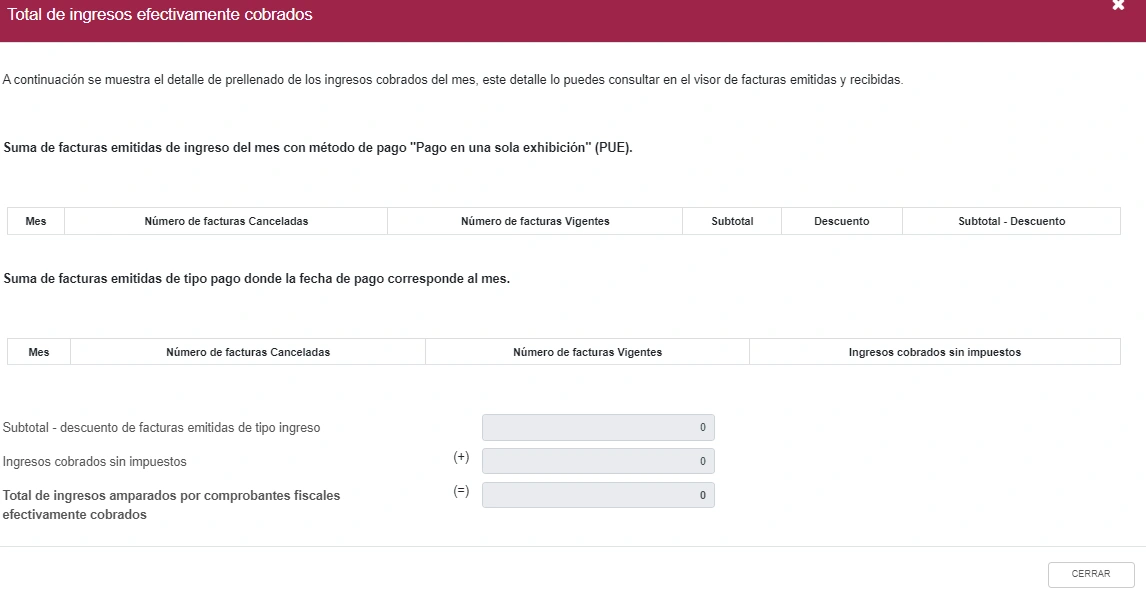
A PUE invoice generally records payment in one installment. A PPD invoice documents a transaction to be paid later or in installments and requires the corresponding payment supplements.
For each invoice, record:
- the income CFDI UUID;
- collection date and amount;
- bank deposit or payment method;
- payment supplement when required.
If you issued an invoice in March and received payment in April, note the payment date and link it to the bank record. Record each installment separately if there was more than one payment. Then compare those records with SAT's prefilled data. An incorrect payment method or missing complement may place the collection in another period.
VAT follows a separate calculation
The absence of income tax deductions in RESICO does not make supplier CFDI irrelevant. Those records may support creditable VAT, business costs, financial statements, and outgoing bank payments.
The VAT close should review:
- collections that create output VAT;
- supplier payments with potentially creditable VAT;
- withholding by customers and withholding made to suppliers;
- zero-rated, exempt, or out-of-scope transactions;
- credit notes, returns, and cancellations.
Do not combine the income tax and VAT workpapers. They use some of the same invoices and bank records, but their tax bases and rules differ.
What RESICO accounting requires

Rule 3.13.17 of the 2026 Miscellaneous Tax Resolution relieves RESICO individuals and companies from sending electronic accounting records and filing DIOT. The relief reduces the files submitted to the SAT. It does not erase the records needed to support revenue, VAT, withholding, and returns.
A useful monthly file contains:
| Control | Minimum support |
|---|---|
| Collected revenue | Valid CFDI, bank record, and customer reference |
| Partial payments | Original CFDI and payment supplements |
| Withholding | CFDI showing the withholding and the amount used in the return |
| Creditable VAT | Supplier CFDI, payment, and evidence that credit requirements are met |
| Cancellations | Request, acceptance when required, and replacement CFDI |
| Returns | Filing receipt, payment reference, and proof of payment |
Keep a list of collections, withholdings and payments alongside the XML files. When you need to review an earlier return, you can then find the source of each amount without searching through customer messages.
Monthly closing routine
The SAT filing service for monthly RESICO payments gives the 17th day of the following month as the general deadline. To reach that date with reviewed figures:
- download issued, received, and cancelled CFDI;
- mark each income invoice as outstanding, collected, or returned;
- reconcile bank deposits and partial collections;
- confirm the 1.25% withholding made by company customers;
- prepare separate income tax and VAT workpapers;
- compare the result with the SAT prefill;
- correct invoice or data differences before filing;
- save the return, receipt, and payment record.
Agree on a document-delivery date with your accountant before the filing deadline. Allow time to request a payment complement or clarify a withholding if the amounts do not match.
Annual return and the current relief
The Income Tax Law provides for an annual RESICO return. The 2026 tax rules, however, may relieve some individuals from filing an annual return for tax year 2025. The SAT page for the 2025 individual annual return points to Rule 3.13.7 and allows optional filing in specified cases.
Do not treat that relief as permanent. It must be checked for each tax year and against the taxpayer's other income. Wages, interest, or income under another chapter can change the procedure even while the business activity remains in RESICO.
When the low rate still produces a poor result
RESICO often works well for a high-margin business with few deductible costs. It may be a poor fit for a business with cost of goods, payroll, rent, equipment, or substantial contractor expenses.
Compare actual pesos:
- estimated monthly and annual income tax;
- expenses that do not reduce the RESICO income tax base;
- withholding and balances that affect cash;
- transition costs if the regime changes;
- expected growth against the MXN 3.5 million limit.
A 1% tax on revenue can exceed a higher rate applied to a small profit. Use a year of collections and expenses if you have that history. If you are just starting, use an estimate and write down the assumptions. Include slower months and expenses you pay only once a year.
Why taxpayers leave RESICO
If revenue exceeds MXN 3.5 million during the year, Article 113-E moves the taxpayer to the applicable regime beginning the following month. When excess revenue is the only reason for leaving, the individual may return in a later year if prior-year revenue falls within the limit and all tax duties are current.
Noncompliance has a harsher result. Article 113-I requires exit after three or more missed monthly payments in a calendar year, consecutive or otherwise, or a missing annual return when that return is required. A taxpayer removed for failure to meet tax duties cannot return to RESICO.
Before amending returns or accepting an automatic RFC update, identify:
- the exact date and reason for exit;
- the regime that applies from that date;
- payments that need recalculation;
- CFDI and notices that require correction;
- applicable inflation adjustments, surcharges, or penalties.
Frequently asked questions
Does a RESICO taxpayer have to submit electronic accounting?
The tax rules relieve RESICO taxpayers from submitting electronic accounting and DIOT. They still need records that prove collections, VAT, withholding, and filed returns.
Does a company always withhold income tax from a RESICO individual?
When it pays for the business activities, professional services, or leasing covered by Article 113-E, it withholds 1.25% from the payment before VAT. The taxpayer should verify the rules for the transaction and confirm that the CFDI shows the withholding.
Are business expenses lost under RESICO?
They do not reduce the RESICO income tax base. They may still support creditable VAT, show the business's real profit, and explain outgoing payments.
What should be reviewed every month?
Valid and cancelled CFDI, bank collections, payment supplements, withholding, VAT, SAT prefill, the filed return, its receipt, and proof of payment.
The control that makes RESICO manageable
Keep one monthly reconciliation that connects issued CFDI, collected amounts, bank deposits and the return actually filed. When those four views disagree, document the reason in the same period. This makes a later correction much easier and helps detect whether the issue is invoicing, collection timing or an accounting classification.