

If the salary registered with IMSS appears understated, replacing it with the contractual wage is not enough. First distinguish agreed wages, payroll earnings, net bank payments and the salary contribution base, known as SBC. The SBC incorporates items defined by Mexico's Social Security Law, so it can differ from ordinary daily wages. The useful comparison is between the SBC applicable to each period and the base actually registered, under articles 27 and 30 of the Social Security Law (LSS).
Which figures should you reconcile?
Publicación de InstagramMostrarOcultar
Original Fintax Instagram publication about IMSS salary registration below the appropriate contribution base.
The contract and amendments document agreed terms; payroll shows earnings and deductions; bank records evidence net payment. Payroll CFDIs support actual earnings within the framework of articles 29 and 29-A of the Federal Tax Code (CFF). As a recommended control, collect these documents alongside IMSS acknowledgments and salary history. A bank deposit alone does not establish gross wages or the SBC.
Article 27 of the LSS includes cash wages, bonuses, premiums, commissions and other benefits. Its exclusions are limited and subject to requirements, including accounting records where applicable. Before calculating, identify whether pay is fixed, variable or mixed: article 30 sets different treatments. Also verify the applicable limits under article 28. There is no universal integration factor for every employee or pay arrangement.
Example: $400 daily wages and a registered SBC of $350
Assume a full-time employee in the general, non-border zone earns fixed gross wages of $400 per day, matching both contract and payroll. The employee is in the first annual benefit band: 12 vacation days, a 25% vacation premium and 15 days of annual aguinaldo. There are no other benefits included in the base or variable amounts, and we assume the base falls within legal limits. These minimum benefits are provided in articles 76, 80 and 87 of the Federal Labor Law (LFT).
Under these assumptions, the factor is 1 + (15/365) + (12 × 0.25/365) = 1.0493150685. Multiplying by $400 gives $419.7260274, displayed as $419.73. We retain decimal precision during calculation. Do not add another 12/365: ordinary wages already cover vacation days; the additional item integrated here is the vacation premium. This reconstruction uses the stated benefits and the integration rules in article 27 of the LSS.
| Item | Illustrative value | Correct interpretation |
|---|---|---|
| Gross daily wages | $400.00 | Before withholding |
| Example integration factor | 1.0493150685 | Depends on the assumed benefits |
| Reconstructed SBC | $419.73 per day | Integrated base, not a contribution payment |
| Registered SBC | $350.00 per day | IMSS record, not gross wages |
| Daily base difference | $69.73 | Not the amount payable |
The $69.73 difference is between contribution bases, not a daily contribution owed. It does not establish a fine or historical liability either. To quantify contribution differences, review valid bases, days, periods and applicable rules for each insurance branch, rather than multiplying the gap as though it were the payment due. If tenure, benefits or earnings change, reconstruct the SBC for the relevant period.
Correct the date as well as the amount
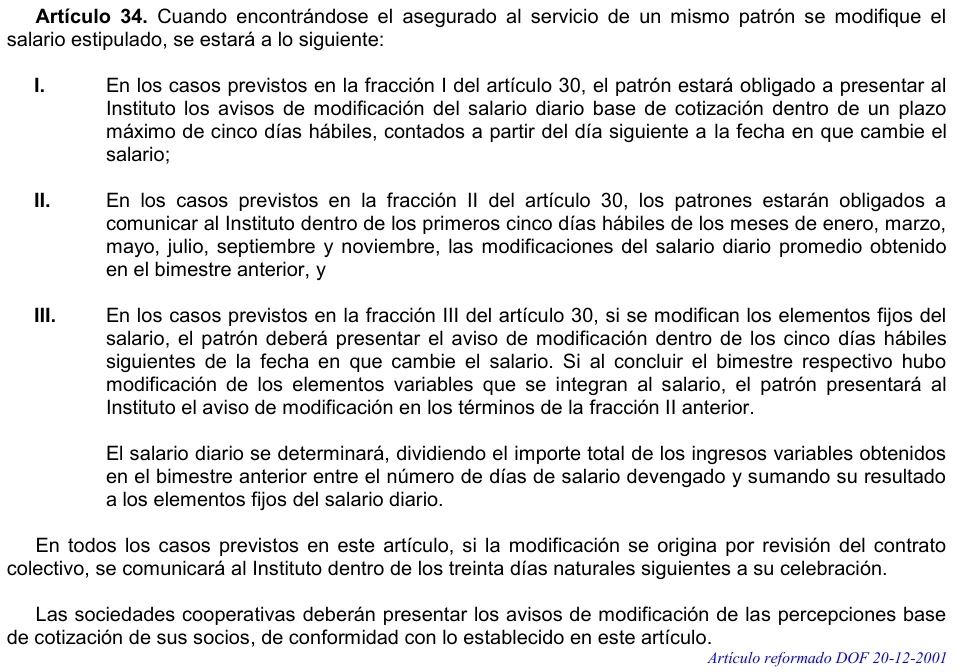
Articles 15 and 34 of the LSS govern records and salary change notices. For fixed salary changes, article 34, section I, sets a maximum of five business days counted from the day following the change. Do not automatically apply that rule to variable or mixed pay. Article 35 ties effects on contributions and cash benefits to the actual change date: using today's date does not replace correcting earlier periods.
Practical controls to resolve the discrepancy
- Build an employee file with the contract, salary changes, payroll XML files, bank payments and IMSS acknowledgments. This is a recommended control for tracing each figure.
- Create a timeline by period showing wages, benefits, tenure, fixed, variable or mixed classification, calculated SBC and registered SBC.
- Identify when each discrepancy began. Ask IMSS which correction route applies to the actual period, submit the relevant correction and retain the acceptance acknowledgment.
- Review payroll CFDIs separately if they contain errors. Determine contribution differences using the applicable inputs and retain the reference for the payment actually made.
- Confirm the updated salary and payment allocation across every affected period. Explain the correction to the employee without promising automatic retroactive benefit effects.
Do not transfer the entire historical liability to the employee
Article 38 of the LSS limits later deductions of employee contributions that were not withheld to four accumulated weekly contributions; the remainder is the employer's responsibility. Review that limit before making any deduction. Source: https://www.diputados.gob.mx/LeyesBiblio/pdf/LSS.pdf
Frequently asked questions
Should the bank payment equal the SBC?
No. The deposit is net of deductions; the SBC integrates items under article 27 of the LSS. Reconcile them through payroll rather than automatically treating them as equal.
Does correcting a CFDI update the IMSS record?
It does not replace the salary change notice. The CFDI falls under articles 29 and 29-A of the CFF; the IMSS change is handled under articles 15 and 34 of the LSS. Verify both records separately.