

When an employee has an accident and is not registered with IMSS, the first priority is urgent medical care and securing the workplace to prevent another incident. Recording the facts, checking insurance status and handling required notices should then proceed in parallel. Waiting to resolve payroll before obtaining care puts those priorities in the wrong order.
A registration window is not automatic coverage
Publicación de InstagramMostrarOcultar
Original Fintax Instagram publication about a workplace accident involving an employee not registered with IMSS.
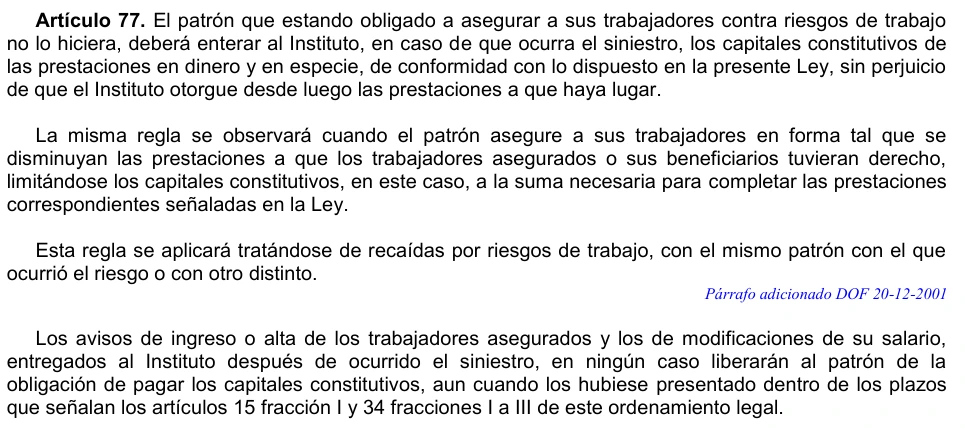
Article 15, section I, establishes the employer's registration obligation. Article 77 specifies that registering an employee after an accident does not release the employer from paying capitales constitutivos, even when registration falls within the periods under Articles 15 and 34. Treating a registration window as days of automatic insurance coverage can therefore lead to the wrong decision. Social Security Law, Articles 15 and 77.
For an uninsured occupational risk, Article 77 provides for the employer to cover capitales constitutivos for cash and in-kind benefits provided by IMSS. It also addresses amounts for differences when insurance results in benefits below the employee's entitlement. Registration or wage changes submitted after the accident do not override that rule. Social Security Law, Article 77.
What to check and which evidence to keep
| Fact | Legal consequence | Evidence | Next action |
|---|---|---|---|
| Accident without insurance | Potential capital constitutivo under Article 77 | Employment start, account and available records | Verify status and official classification |
| Registration after the accident | Does not release Article 77 liability | Submission receipt with date and time | Preserve the actual timeline |
| Workplace accident | Notice under Article 504, section V | Accident details and location of care | Coordinate notice within 72 hours |
| Death resulting from an occupational risk | Separate notice under Article 504, section VI | Record of when the death became known | Notify as soon as it becomes known |
| IMSS assessment | Amount determined by IMSS | Assessment, calculation and notification record | Review legal basis, items and applicable deadline |
The table's legal consequences come from the Social Security Law, Articles 77 and 79, and the Federal Labor Law, Article 504, sections V and VI. Keeping a dedicated incident file is a recommended control, not an additional statutory form.
Example: registration six hours later
Suppose an employee starts on Monday, has an accident on Wednesday at 10:00 a.m., and the employer submits registration that Wednesday at 4:00 p.m. For this hypothetical example, assume the employee was uninsured when the accident occurred and the event is classified as an occupational risk. The file should preserve all three points in time, without changing the employment start date or altering receipts. Even if the initial registration period had not expired, the 4:00 p.m. submission does not eliminate Article 77 liability. Social Security Law, Article 77.
Separate tasks with clear responsibility
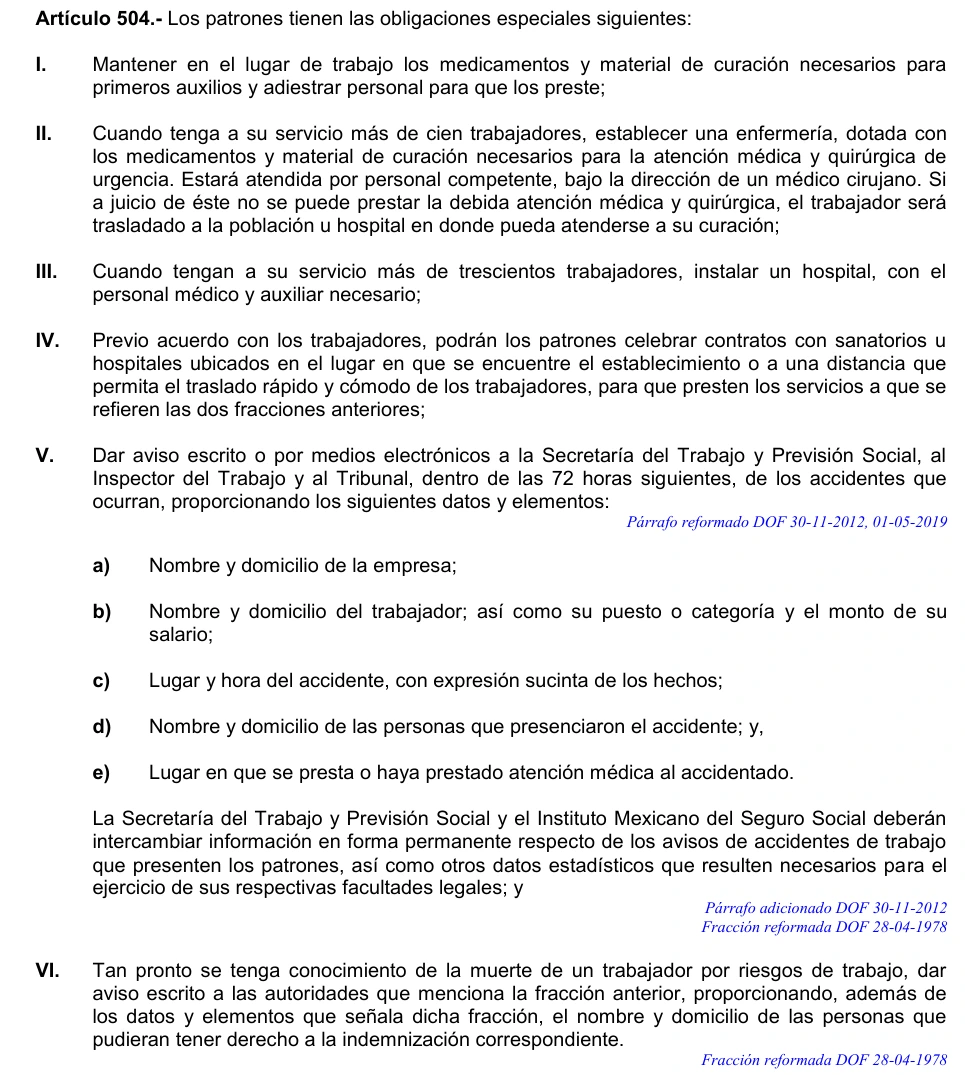
- Care and safety: arrange urgent care and prevent further hazards. The Federal Labor Law requires first-aid materials and personnel trained to provide first aid; this does not replace medical care. Article 504, section I.
- Facts and insurance: assign someone to gather employment records, payroll, submission receipts and an account of the accident. Preserve original files and timestamps. Address the registration issue with specialist support, without fabricating or backdating documents.
- Notices: immediately coordinate with specialists the written or electronic notice to STPS, the Labor Inspector and the Tribunal, within 72 hours. Include employer and employee details, position, wages, place and time, witnesses and location of care. For a death resulting from an occupational risk, notify as soon as it becomes known, rather than waiting those 72 hours. Article 504, sections V and VI.
- Assessment: if one arrives, identify the document, amount, items, legal basis and notification date. Have the applicable response and deadline reviewed for that specific document; do not assume one universal remedy.
Frequently asked questions
Should the employee still be registered after the accident?
The outstanding registration obligation must be addressed, but registration should not be presented as a retroactive solution. For future hires, confirming registration before exposing an employee to work is a recommended preventive control. The registration obligation and the effect of registering after an accident are separate questions. Social Security Law, Articles 15 and 77.
Is capital constitutivo a fine or a monthly contribution?
No. A periodic contribution belongs to social security contribution obligations; a fine is a penalty. Capital constitutivo concerns the benefits specified by law. IMSS determines the amount: it can include medical care, hospitalization, medicines, prostheses, cash allowances and pension-related components, plus 5% for administrative expenses. This rule does not establish a universal cost per accident. Social Security Law, Articles 77 and 79.