
Choosing the lowest tax rate can hide the decisive question: how much of your spending actually reduces the ISR income tax base? For an individual operating a business, the general regime allows authorized deductions. RESICO calculates ISR on income actually collected, excluding VAT and without deductions. These are different tax bases under Articles 103, 105, 106 and 113-E of Mexico's Income Tax Law.
A useful comparison starts with verified collections and expenses, rather than your bank balance. Spending may be necessary to run the business but still need review before being treated as deductible. Each alternative also requires eligibility and a valid election: the scenarios below are not an invitation to switch regimes each month.
Publicación de InstagramMostrarOcultar
Original Fintax Instagram publication about comparing RESICO and the general business regime.
What changes between the two tax bases
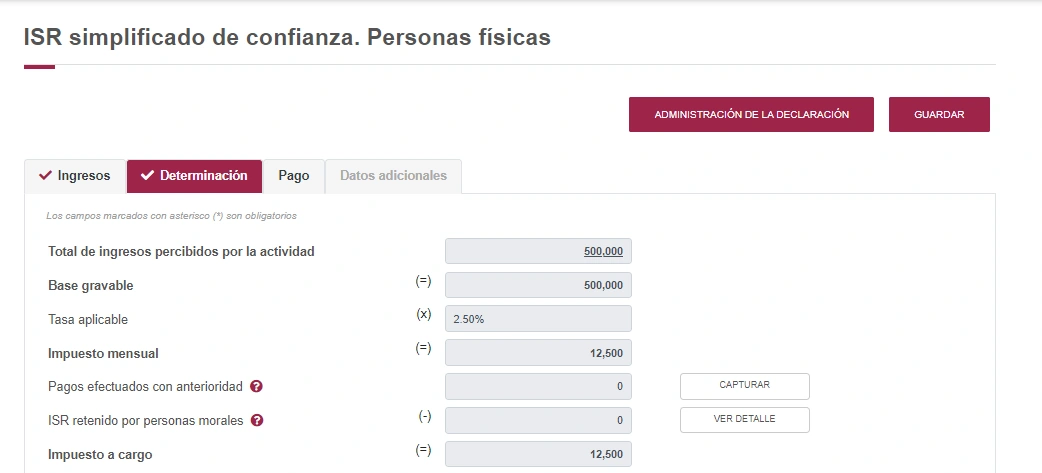
Under the general regime for individuals carrying out business and professional activities, deductions must be authorized and meet the applicable requirements. Provisional payments use income and deductions accumulated from the start of the year. Under RESICO, expenses do not reduce the ISR base. These distinctions appear in Articles 103, 105, 106 and 113-E. Holding a CFDI, Mexico's electronic tax invoice, does not replace checking the other requirements.
The payment's scope differs too. Article 106 provides for provisional payments under the general regime, with an annual tax calculation. For individuals in RESICO, Rule 3.13.7 of the 2026 miscellaneous tax resolution makes monthly payments definitive and provides annual filing relief only for RESICO income. A one-month comparison therefore cannot establish which regime produces the lower annual tax burden.
Worked hypothetical example: January 2026
Assume an individual makes ordinary sales to consumers and actually collects MXN 60,000 in January 2026, excluding VAT. There is no other income, withholding, employee profit sharing (PTU), losses or investment expenditure. We compare two prospective alternatives for which the individual would be eligible and could make a valid election. In both scenarios, current expenses are paid, authorized and fully meet Article 105.
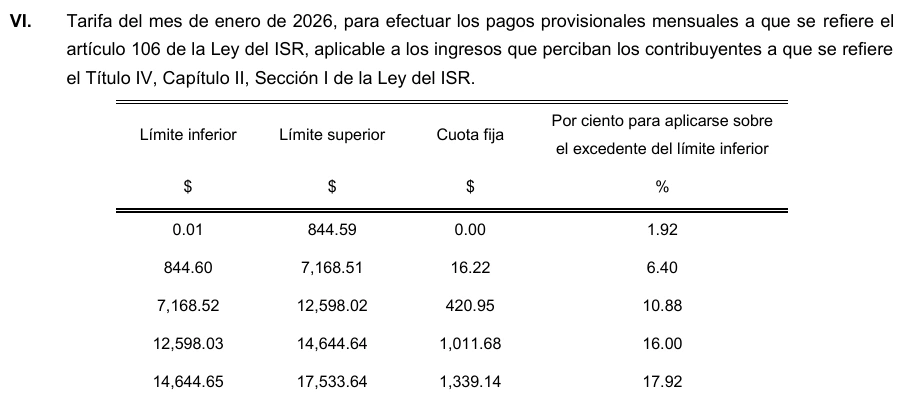
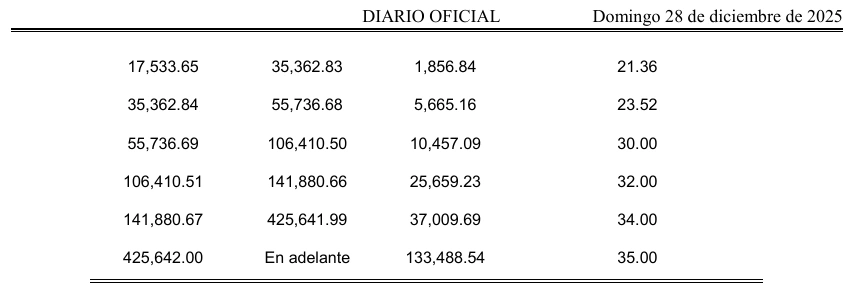
The general-regime tariff used here is exclusively the January 2026 tariff in Annex 8, section B.VI, pages 6 and 7. For MXN 60,000 collected, Article 113-E applies a monthly RESICO rate of 1.5% to the entire base, rather than as a marginal rate.
| January 2026 item, all amounts in MXN | Scenario A | Scenario B |
|---|---|---|
| Collections excluding VAT | 60,000 | 60,000 |
| Verified deductible expenses for the general regime | 40,000 | 55,000 |
| General-regime tax base | 20,000 | 5,000 |
| General-regime January provisional ISR | 2,383.65 | 282.17 |
| RESICO January definitive ISR | 900.00 | 900.00 |
Scenario A, January 2026: the general-regime base is MXN 60,000 − 40,000 = 20,000. Provisional ISR is MXN 1,856.84 + (20,000 − 17,533.65) × 21.36% = 2,383.65236, rounded to MXN 2,383.65. Subtract the bracket's lower limit when calculating the excess, not its fixed tax amount.
Scenario B, January 2026: the general-regime base is MXN 60,000 − 55,000 = 5,000. Provisional ISR is MXN 16.22 + (5,000 − 844.60) × 6.4% = 282.1656, rounded to MXN 282.17. In both January 2026 scenarios, RESICO is MXN 60,000 × 1.5% = MXN 900.00.
This is tax arithmetic, not a profitability measure
Scenario B has lower general-regime provisional ISR but also higher expenses. The table does not measure available business cash or establish which regime would produce lower annual ISR. A bank balance is not the same as profit.
Practical controls before deciding
The tax requirements come from the Income Tax Law; the workflow below is a recommended control for applying them consistently. Keep evidence connecting each expense to its CFDI, payment, business need and activity. Resolve discrepancies before including the expense in your comparison.
- First verify eligibility and a valid election for each alternative. A favorable calculation does not make a regime available.
- Reconcile income actually collected, excluding VAT, against sales records and collection transactions.
- Separate current expenses, investments, personal spending and unpaid items. Do not treat every bank outflow as an immediate deduction.
- Check which expenses are authorized and satisfy Articles 103 and 105. Keep a separate column for items awaiting supporting evidence.
- Model several representative months and the general regime's annual calculation separately. For later months, use the corresponding cumulative tariff, not January's tariff.
- Assess operating margin and compliance work alongside ISR. High business expenses deserve attention even when they reduce the provisional tax payment.
Frequently asked questions
Do high expenses automatically make the general regime better?
No. What matters is which expenses are actually deductible, their size relative to income, and the general regime's annual calculation. Scenario B shows a lower provisional payment in January 2026, not an annual advantage. Deductibility must be checked against Articles 103 and 105.
Can I choose whichever regime gives lower ISR each month?
That is not how to use this comparison. It assumes eligibility and a valid election under Article 113-E, rather than monthly switching for a better result. Use the scenarios to support a planned decision based on reconciled collections, verified deductions and an assessment of the full period.